






|
|
CASA ORNATA - INTERVIEW WITH DANIEL BAUMANN MAFALDA TEIXEIRA2025-12-08
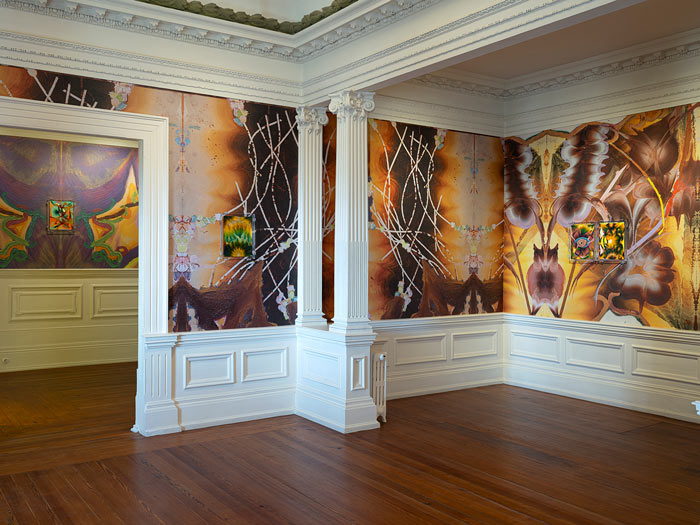
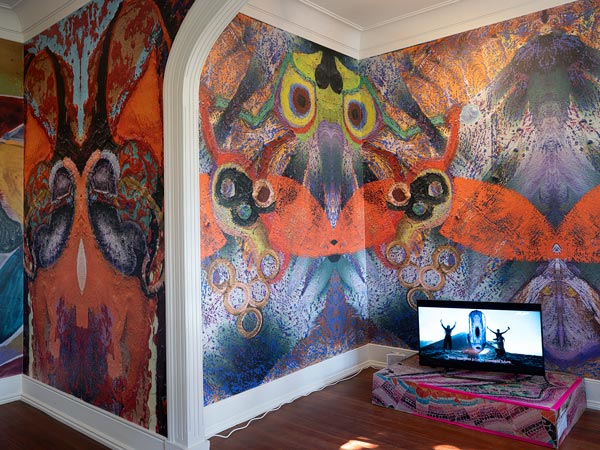
Presented as a multi-layered, continuously unfolding painting, the exhibition Casa Ornata by German artist Kerstin Brätsch (1979), on display at Casa São Roque – Centro de Arte (Porto), explores the relationship between the pictorial medium and the viewer's body – psychic, physical, social, and mental – allowing access to hypnotic states and kaleidoscopic situations. Disruptive and counter-current, Brätsch's colorful and grandiose compositions, dominated by abstraction, explore the nature of painting in the digital age, revealing the artist's transformative vision. By evoking flows of energy, cosmic forces, unconscious desires, or mental states, the artist's sensual and playful visual universe is in a constant transformation, leading us to question what painting is and what its limits are. Adding depth and complexity to her artistic practice, Casa Ornata places Brätsch's work in dialogue with the history of art, architecture, and the mansion’s decorative elements, in a logic of interaction and integration. Regarding the Casa Ornata exhibition, we spoke with Swiss art historian Daniel Baumann (1967), the show’s and Casa São Roque’s curator.
With exhibitions, you always wonder whether to give them a title, sometimes the artist’s name does the job. I think Kerstin had this idea for the title for different reasons. First, when you're in Porto, you see all these houses with the tiles, and ornament plays a vital role in architecture in Portuguese architecture. The second thing is that everybody wants painting to be much more than ornamenting a house. I think Kerstin took it a bit as an homage to Porto. Still, it is also a bit of a provocation towards the idea of painting as painting, not wanting to be, or trying to be, much more than decoration, ornament and so on. The title plays around these topics: homage and maybe a comment on her own practice and the job.
That exhibition space [New Jerseyy gallery] was ran by four people, and I was one of them. It was a very small independent art space, and we did twelve exhibitions every year, very fast. We knew Kerstin and Adele, we invited them for a show, and it became a adventurous collaboration. We made some cakes in the form of artworks; one was like a Giacometti chocolate figure that then melted. It was playing with the idea of “big art”: celebrating big art but also making fun of it, having a laugh about art being so sacred or taken as something exceptional, almost non-human. Working at CSR, I had seen how they had made exhibitions. They used the house in a classical way to stage exhibitions, selecting works, hanging them on the walls or installing them in the rooms. I had done that before in April as well, when I installed Pedro's exhibition collection [Coleção Peter Meeker - Obras de 1988 a 2024] because first, I wanted to know Portuguese art, and secondly, I wanted to understand how this space works. I thought about the potential of the house; CSR is very unique and not a classical exhibition space. It needs a different exhibition and someone who transforms the house into something else - and who could do this? Kerstin Bradshaw! I knew her, and had seen her installation BAUBAU at Berlin`s Gropius Bau, for children. I thought this would be interesting to bring to CSR, because there's something about the psychedelic aspect, and then this bourgeois house. Nevertheless, in CSR you have the winter garden, which is also a little, almost psychedelic. Kerstin came and was immediately very enthusiastic. For each room she chose the wallpaper that she thought would make sense, and many of her choices I didn´t expect. I let the artists work, that's what I usually do. If I see I can contribute or ask a good question, I do, but otherwise I trust the artists to do their job. The only thing I said at some point was: Kerstin, let's keep one room white, without wallpaper. Let’s show your paintings or drawings without the wallpaper, just as they are. This is a very small, beautiful room with good light. Let's keep this empty and hang some of the works there, so people can really look at your art. Don't hide it in this wild visual environment. We know each other, if either of us disagrees, we say: can we do it differently? You argue, you talk to each other, it's a discussion - and that’s the fun.
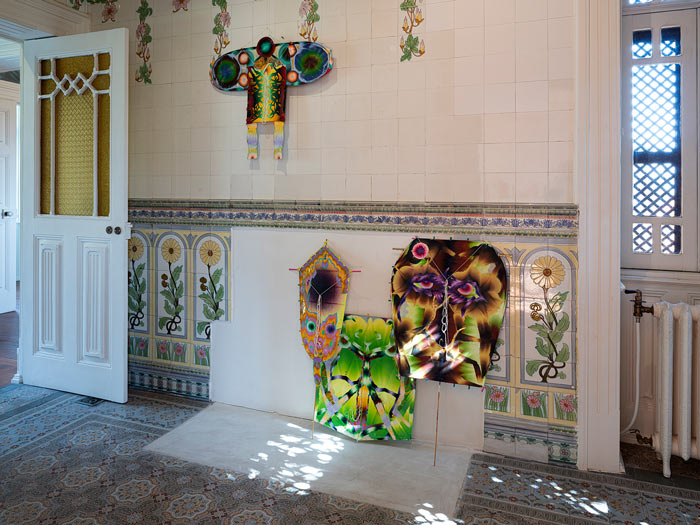
Kerstin had the idea where to put the kites, the drawings, the wallpapers upstairs, these significant paper works. What I found interesting, what I learned with this exhibition, is that everything – however it doesn't look like it – it is about painting. It's a different way of painting: at first you think it is an installation, a drawing, booklets, or wallpaper, but at the end of the day, everything is about painting and making painting in different ways. Sometimes this happens with other people, collaborating with technicians, with friends; sometimes they're part of it, and works come out of this almost like a performance. There is a community aspect. Sometimes they emerge from this symmetry thing, this psychological test, the Rorschach test. I think all these works circulate around the question: how can we do paint nowadays? How can we overcome this old idea of canvas painting, the heroic male history of the man doing beautiful paintings with a nice frame around them? Here, you have none of this. You don't have nice frames; you don't have nice canvas. Even these Plexiglas frames, they're part of the work, they're not just framing the drawing - they're actually together with the drawing, they are a work. Usually, people think that painting it's a very serious practice, for prominent painters with big brushes, for big museums and for wealthy collectors. Kerstin develops a form of painting for everyone: accessible, playful, and actually really good. I think she hides its quality a little bit. She paints in a way that I don't see often. She brings painting back to the people - that’s what I think - it’s completely different, and she is actually making fun of power all the time, but it's still serious. It serves the people, the audience, whatever your background - education, origin - you can find something there. People find all sorts of different things in it because it is playful.
I never thought about painting-painting when I thought about her work. Still, doing this exhibition in Casa São Roque, I realized that everything is about painting. And if we say painting - that's what Kerstin said - you have to talk about light. Painting, color, it's so much about light, it depends on whether you have the light in the evening or the light during the day. And, again, Casa São Roque is not a museum where you always have the same light, it it never stays the same. Most museums have one light, and that's the only one. In Casa São Roque you have living light. You have all sorts of different lights. She plays with the concept of light by placing colored foil on the windows. In the upstairs space, the windows are pinkish-red. if you change the color, the painting will be different. Downstairs, she added turquoise, and in the basement, yellow. Not many painters shift the light in their space, because is basically you making fun of your own paintings, so you change how they look. If you put them into pink light, these paintings look different and she's not afraid of that. Again, she's not saying this painting is an authority, it's sacred, it's a value, but rather that it's a living entity. I think that's why light is so important. Because for her, light adds life to art, to the painting. I think that's why she does it.
When Kerstin decided to put wallpapers all over the place, I suggested keeping one space without it, like a classical exhibition space, because I think you learn from contrast, you learn from being able to compare two things. You can see the difference it makes to the architecture. How does this house look when you put wallpaper, and how does it look like when there is no wallpaper and white walls? Secondly, I also suggested: let's put your paintings just in front of a white wall so that we can really see them. The contrast was significant. It's not one or the other, it's always both, a dialogue, an extension.
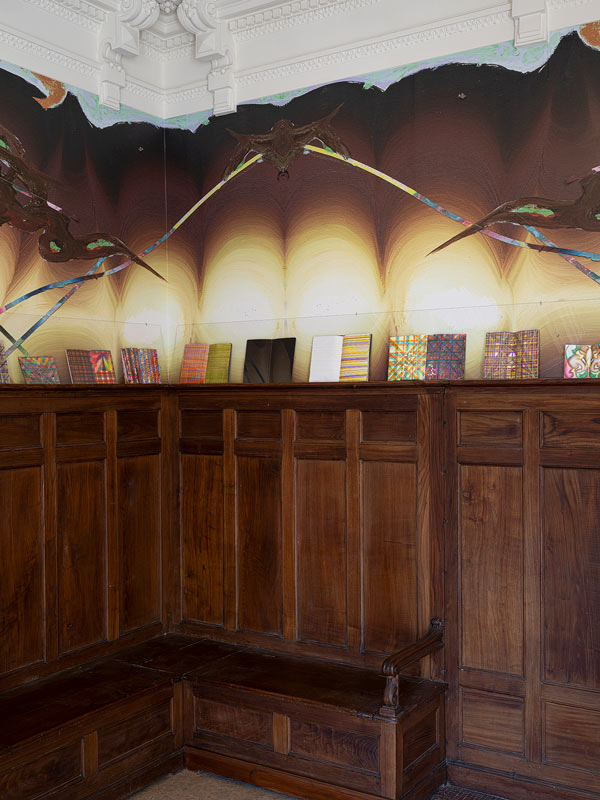
It was again her idea. Going downstairs, she saw these wooden panels with a cornice and decided to put the booklets there. She started them before becoming an artist (…) she was just making drawings in a book, like a diary, and continued doing them. Those are the most private things she does. Although it's just abstract, it's not writing.
I'm really discovering Portuguese art in a very different way. When I'm in Lisbon or Porto, I see Galeria Municipal because they both [Porto and Lisbon] have very active programs with younger Portuguese artists. I see galleries, I go to Culturgest, both in Lisbon and Porto, I go to Serralves for their exhibitions.
I must say I enjoyed coming to Porto very much, discovering all this unknown world for me, bringing it out, and talking about it. There is so much interesting stuff going on. Still, not a lot of people know about it – in Portugal, yes, but outside of Portugal, less. Now it needs more people to come, and that’s what we [Casa São Roque] are doing.
The thing that is happening now is that we see artists from outside moving to Portugal, so soon you will have artists from everywhere. There is Dozie Kanu (1993), an American artist based in Lisbon with an international career. Another one people talk about, whose work I know, is Bruno Zhu (1991). He is Portuguese, he grew up in Portugal, but he is from a Chinese family. The entire world is changing fast. The first reason why I even came to Portugal was Ana Jotta (1946) and her work, then I found others. I'm still at the beginning of my larger research, and I’m definitely looking into many things. So far, it has been a pleasure to visit your country and also to talk to people. It's very lively, I must say. It's a good time to be here.
:::
Daniel Baumann |