







|
|
ROSA BARBA
27/07/2026
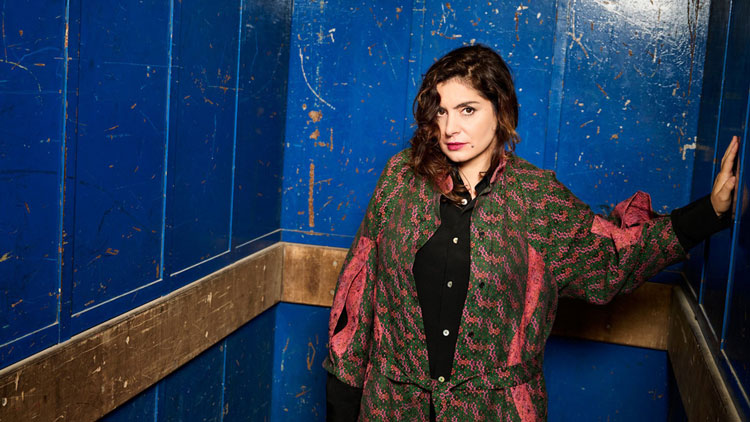
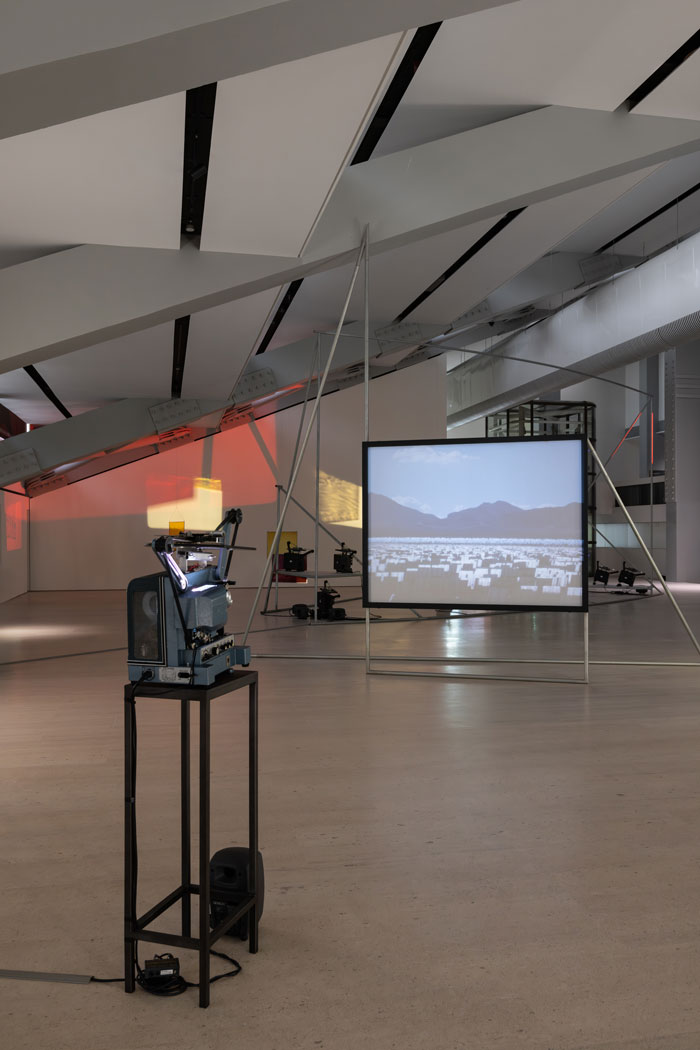
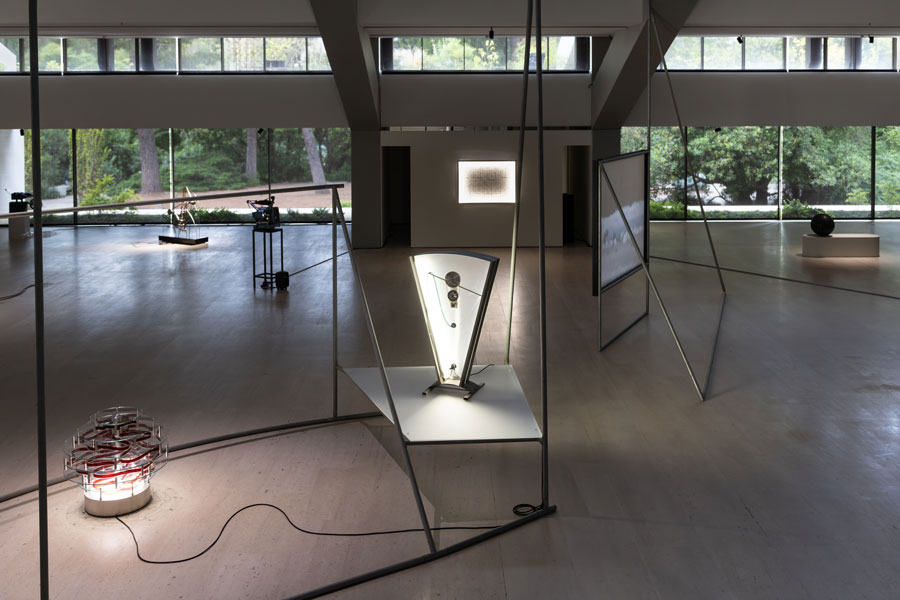
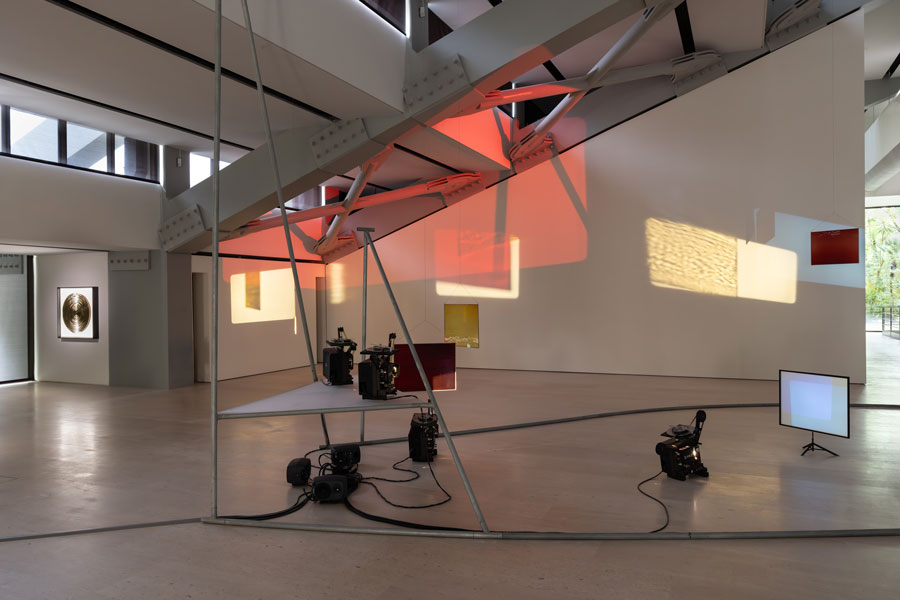
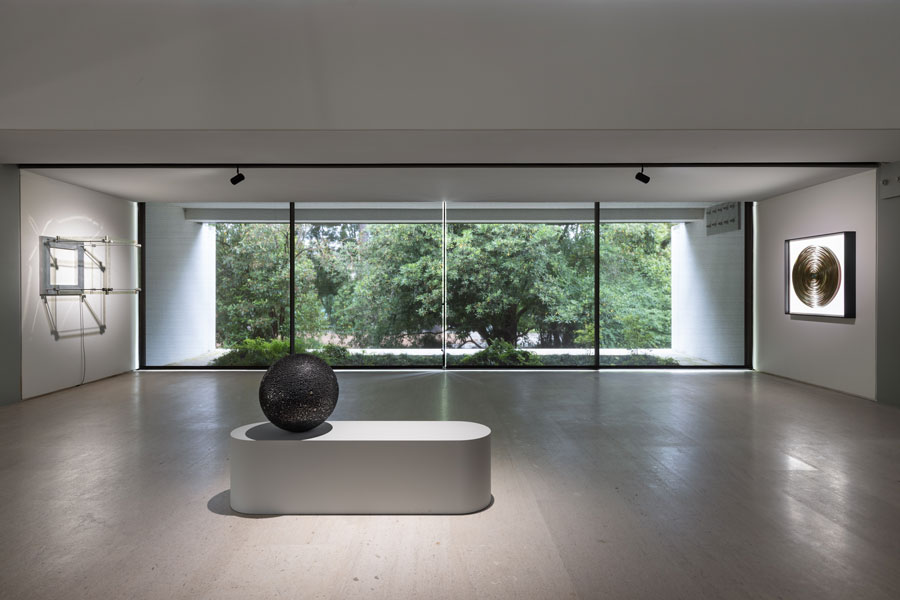
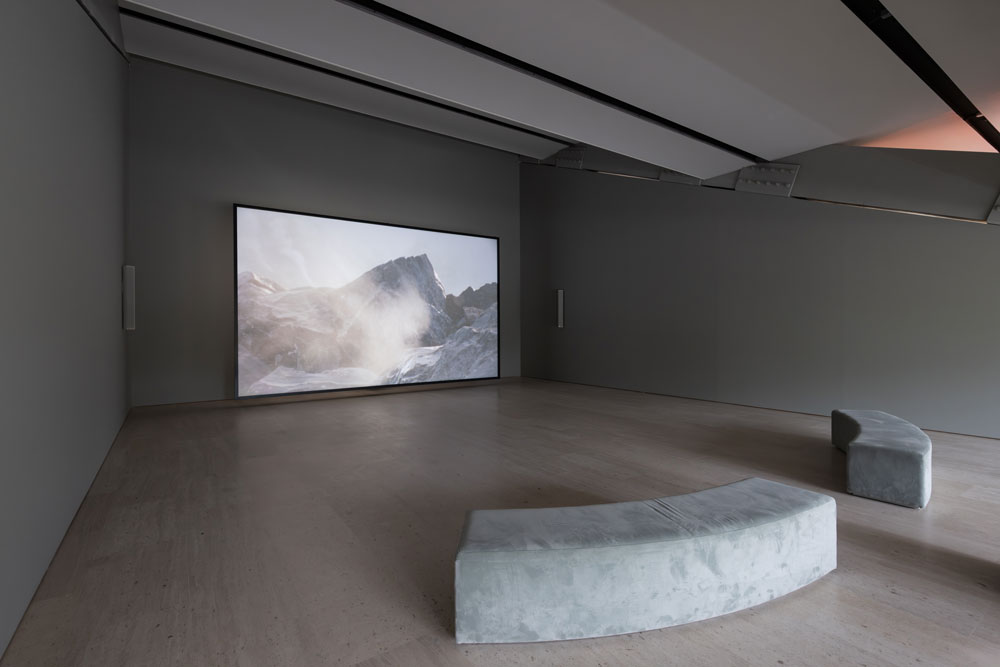
Currently exhibiting at CAM - Fundação Calouste Gulbenkian, Rosa Barba is an Italian-German artist whose work investigates the temporal, material and spatial conditions of cinema, inherently treating film as both a medium and sculptural apparatus while presenting complex films. She recently presented The White Museum, a work series that embraces the reconfiguration of a museum, at the Centre Pompidou and received the respected Zurich Art Prize, accompanied by an exhibition at Museum Haus Konstruktiv in Zurich.
Interview by Mariana Varela
>>>
MV: Hello Rosa. Thank you very much for our conversation. Let us start straight away with a question about the Zurich Art Prize you recently won. On one hand, I would like to ask you about the relationship between the Haus Konstruktiv and your work. On the other hand, my interest is in how receiving this prize resonates with your work at this very moment.
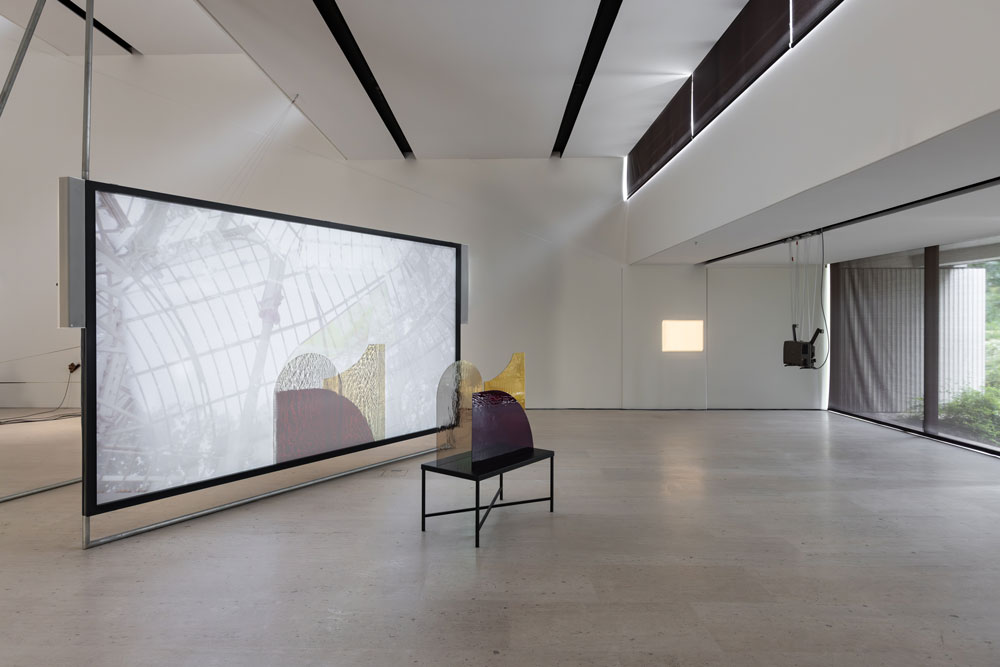
RB: It is a nice recognition, the prize money is for a dedicated exhibition at Museum Haus Konstruktiv in Zürich. The Museum, among other categories and focuses, has a collection on Constructivism. And some of my works relate quite closely to that. In that sense my work extends of the idea of Constructivism. However I actually think my work goes very much in the direction of Deconstruction. In terms of considering the exhibition’s setting, the space is rather classical there, in Zurich. So in a way it was more challenging how to essentially deal with the space and navigate it. For example, at CAM, in Lisbon, the space is very complex in terms of its architecture. But it somewhat feels easier to go in and work with it, expand it. In Zurich the space has this generic touch, and assembling work for that was provoking and quite challenging for me. It was also about, how to bring this vocabulary that I have developed through these last exhibitions, how to present my work and bring it into vibration, into creative and critical dialogue, and how to conduct this within a more classical gallery space. It is rewarding to see that it turned out quite well. There were a few interventions that I made in Zurich, such as building a space within a large space by following the interrupted ceiling construction, which I used then as a large cinema screen and a hidden space behind for the work Stating the Real Sublime.
That allowed me to bring the space into a novel perspective, including the way the works were situated within it.
MV: In Lisbon there is a lot of clarity, right? There's a lot of light.
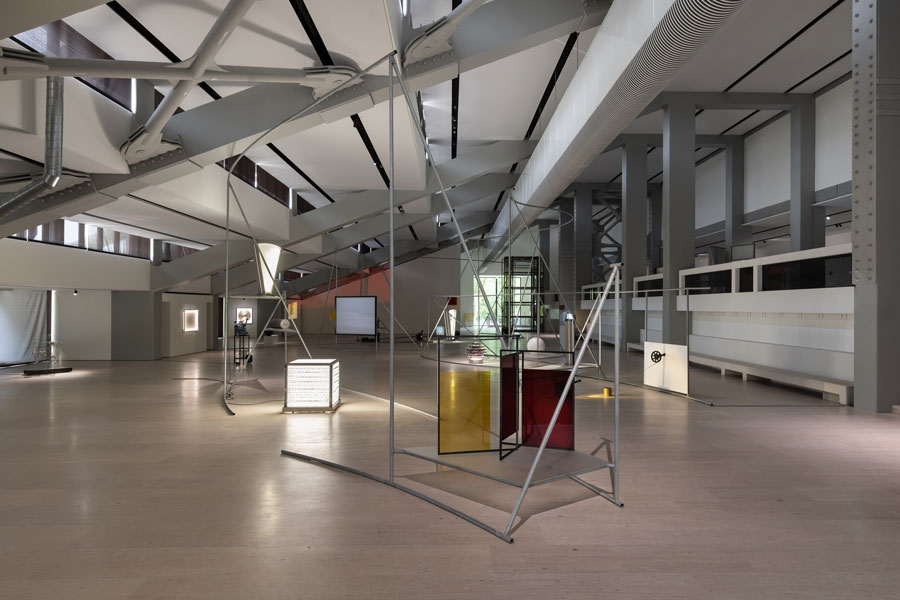
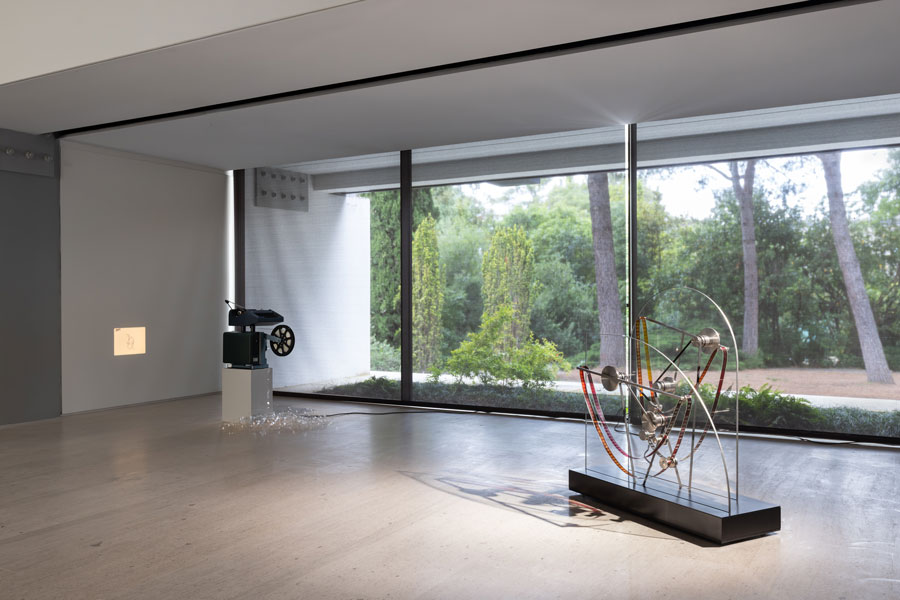
RB: Yeah, there is a lot of light. But the elaborate structure contains a lot of crucial information too, with the pillars, the elevators, the roof, and then all these little windows. So to a certain extent the structure is already so full that you need to create a specific tension in the way you place, or even perform, frame, your work within it. I've learned over the years that you have to play with the space, play with space. It requires to become an elementary part of the work in some way. If you start to ignore it, you fail. If you try to overpower it, you also fail. Thus the structure was very fundamentally related to the kind of space I was working, moving in.
MV: What kind of space do you enjoy or favour to work with?
RB: In general spaces inspire, fascinate me very much, and there is a tremendous joy, but also sense of empowering when working with space. I feel effectively provoked by the challenges of different kinds of spaces. But if I could choose, my preference is for spaces where there is some opening to the outside, some sort of membrane. There are these almost little cinemas within the space itself at CAM, where you can see the outside garden and who also allow the public space to come in. Inverting the environs so to speak. This is exciting. When a space has that multiple or manifold quality, this means a potent site for me, when it doesn't feel completely disconnected from the public.
MV: And the pieces change in different spaces, correct? I'm remembering One Way Out (2019), the one with the tubes, where the strip of celluloid runs through them. So I'm wondering how much the artworks transform and possibly expand as they move from one space to another.
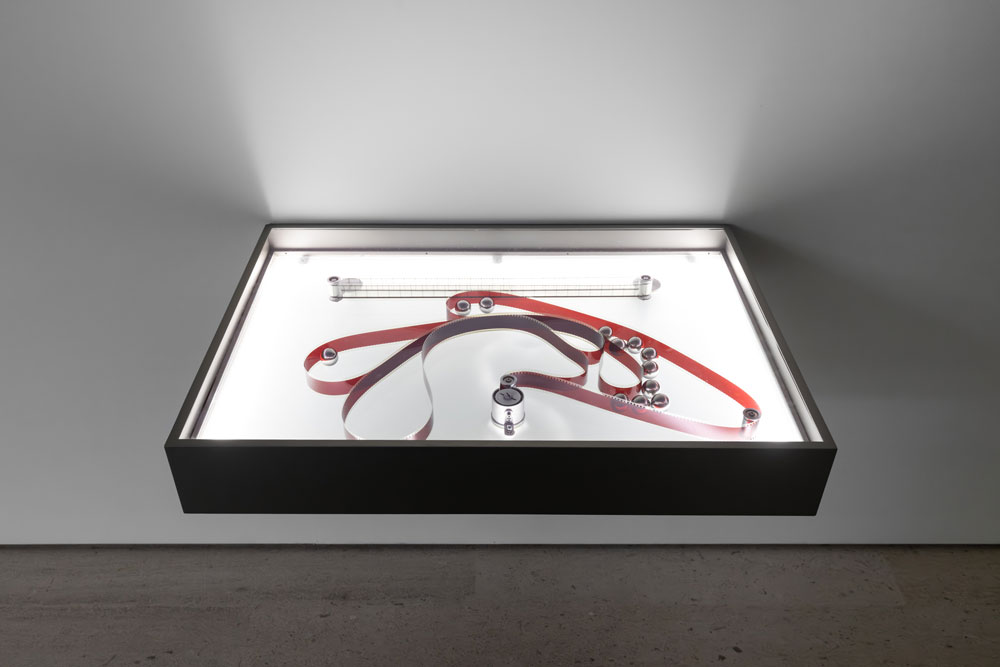
RB: Yes. There are several site-specific works, but they are so in different ways. For example, One Way Out (2009), this installation with a 16mm film, optical sound, projector, ventilator and tube. The tube structure is built according to the specifities of a space, so it can be longer, bigger, or shorter, and so on. Then there are other works where maybe they don't change so much visually, such as the wire piece but the sound changes, modulates, because it reacts to the very space. Indeed some works transform very much with the space, while others are more contained and simply sit on whatever structure they are placed on, or on the wall. Even then I would say they are similar to a musical score. Some are more like exclamation marks or full stops, while others are the notation itself.
MV: A lot of your work resonates with poetry and language. I notice this on many different levels, and was curious about the place that language, poetry, and music occupy in your interests.
RB: There is a kind of ongoing constructing and deconstructing of language, grammar, but also of structures and architecture. It's all very movable, immanently moving, pulsating, if you like. It is highly active stuff, matter, relations. I believe there is a strong relation to poetry throughout because of this kind of fragmented thinking, of sometimes zooming in on just a few words or a thought, then leaving space, then moving to another one, and putting these things, fragments, together in a rhythmic organization. That is essentially how I work in the studio and how I write. Poetry is thus incredibly inspiring to me because it teaches me to think in a different, deviating, way, or in another kind of space, one that gives you a further perspective –window as it were.
A lot of things around us is so organized. Language is certainly organized. For example, you also asked me about teaching. In that context we do lecture series, seminars and the like, so you have to deal with texts or prepare something in writing. Then there is a good amount of editing, and, on one hand, I love that too, this process of pursuing precision in language. But on the other hand you also have to follow the rules very closely, attentively, and occasionally that doesn't give you enough space to escape. That's where my devotion for poetry lies: at some times you can forget about all these rules and simply let the words interact with each other.
MV: Yes. When we think about prose, about narrative, we think in a more linear and logical time and structure. Poetry allows us to play with time, to put things in different places too. And thinking about it, is cinema, or the materiality of cinema, something in itself – or is cinema also some kind of metaphor for time, for you?
RB: I guess both. I mean, they are for sure also standing for something else. But indeed everything is linked to time on way or other. Come to think of it, cinema is both because it’s really about going into all these materials and elements. Yet what is more compelling is actually creating this other time capsule, which these elements allow me to do. In that sense there is an essential conceptual approach, using these elements to allow ideas to become something bigger somehow.
MV: As a medium.
RB: A medium, a thought, or a methodology on its own.
MV: And in your book, On the Anarchic Organization of Cinematic Spaces: Evoking Spaces beyond Cinema, there are these words that keep appearing, flicker, for example. And there is the relation between flicker and memory that draws me in. Because although there are several works that use flicker in an experimental way, I was wondering if this is also related to memory, or to involuntary memories, that said.
RB: Yeah. The flicker is like this little space that makes you dive into the subconscious, or into something that you cannot completely control. The way I organized the pages in the book is also meant to create those side thoughts that come in and sometimes just shake things up, because they bring in a different instrument. Like, okay, don't think about this word in that way. It can also mean this. Then you have that on the side, you bring it in, and it changes the path of your reading because it gives you this information from the side, margin, periphery of mind-vision. It is a sort of flicker in a way as well. A flicker that comes from the page’s side, making you rethink or simply modulate the reading.
MV: And you have this work, Subconscious Society... And in your book you write about drawing as a method of filming too, which means not searching for objects or landscapes, but letting them find you –as if you already carry these objects inside you. Rather than you're searching for them, you somehow encounter them. Can you elaborate a little bit on the unconscious in your work?
RB: Basically, drawing or using the camera as a drawing instrument, is equally a way of finding this subconscious, or these images that you have inside you, or this kind of. . . not only images, but something that drives you, which you accumulate over your life. There are consistently novel inscriptions inside yourself. And if you are open to it, your senses are constantly being built up. In that sense maybe your senses can take on new forms too, beautifully so, speculatively. With the camera, it is thus a direct translation of what you carry inside and what your senses want to lead you to. You carry this camera, and the camera becomes this kind of translation method for the subconscious, for the thoughts and images you have with you, that you inherit. It is leading the movement. So it is his internal process and it is also the movement of the body, a very direct translation. That is also something very specific to you. Bodily movement is unique: everybody has a specific, inherited way of walking, a distinct way of moving. Ultimately it is another sort of thought that comes through the expression of your body as well. That is why I cannot use a drone. I really want this to be part of the filmmaking, as its own kind of language that comes from your body.
MV: And what do you think are the most prominent landscapes or objects that have found their way into your films?
RB: I mean, I think everyone has this different skin through which things sink into you. There is a certain kind of imagery that makes me want to film it. This is an unconscious drive. So when those things appear to me. . . And I believe it's also about where you travel to because you've read something particular, for example, and you already go to these places that you somehow want to find. I guess they are frequently landscapes that we have manipulated as humans, but also historically charged places where you feel there has been an accumulation of events layered on top of each other. And you somehow navigate through them. There are these ruins, these enigmatic forms that capture some kind, corner, niche of history. And then certainly an extensive amount of these Anthropocene moments.
MV: It's interesting because there are some places that, if we approached Earth one hundred years from now and saw these things, they would appear as a lost vocabulary.
RB: Exactly. Those are the things, ‘events,’ that I call a sort of modern archive. It is an archive that we are constantly building, and that on occasions we build without taking responsibility for what it will say in the future, or what effect it could have. Thus I consider all of this as a kind or modelling of modern archive collection that requires to be investigated while it's happening.
MV: And there are other works in which you work with the idea of the archive, right? A Fictional Library, for example.
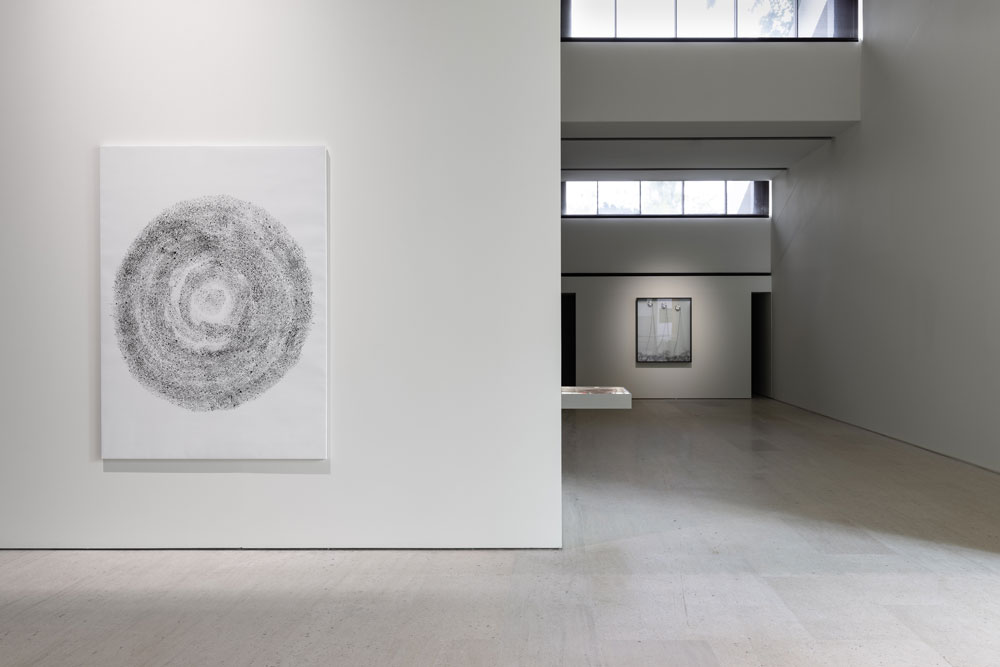
RB: Fictional Library is basically a modulation of a diagram that I started years ago, even before I was working on this book. It's about bringing different thoughts and works into an infinitely changing relation. These are diagrams that are constantly growing and changing. I call it a fictional library because it is an accumulation of words, themes, and methodologies, and there is an ongoing reorganizing of them. They exist as a drawing, but then, in the film Plastic Limits, for example, made five years ago, they also exist as a sort of flicker on the side of the film. I shot the film keeping the frame completely open to use the maximum space of the film material. That gave me more space, and that was used to include this fictional library alongside the imagery. It is a sort of methodology. The Fictional Library is in constant activation. It is never finalized. Maybe someone else will continue it one day, hopefully. It's basically an active proposal, agential realism-speculation.
MV: Now moving a little bit to the films and to cinema itself. There are some interpretations of your work as expanded cinema, right? My question is whether, for you, changing the way cinema is presented architecturally is also a way of changing the meaning of cinema.
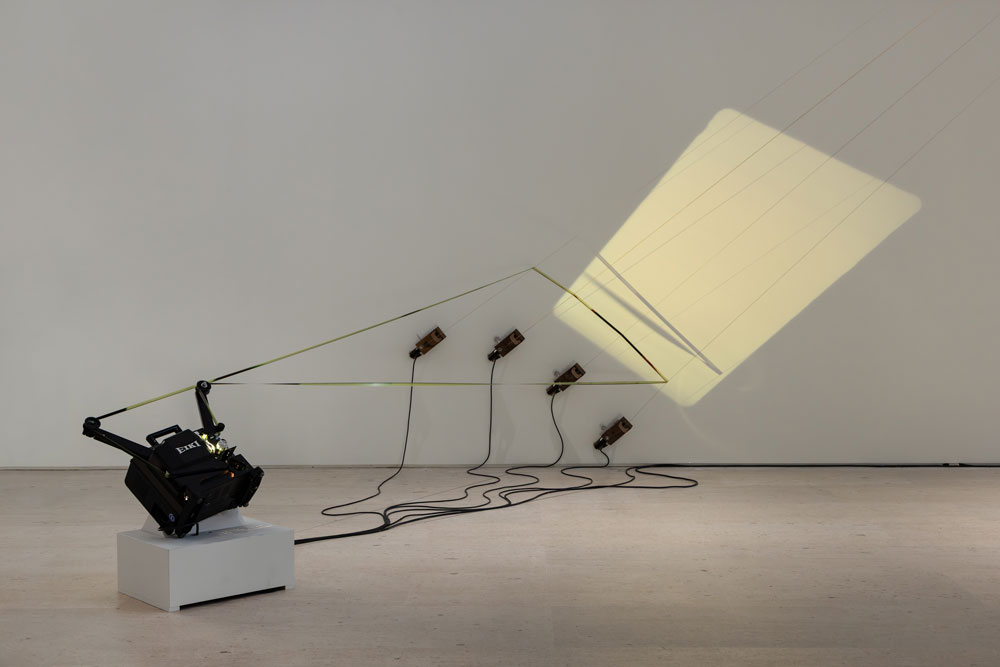
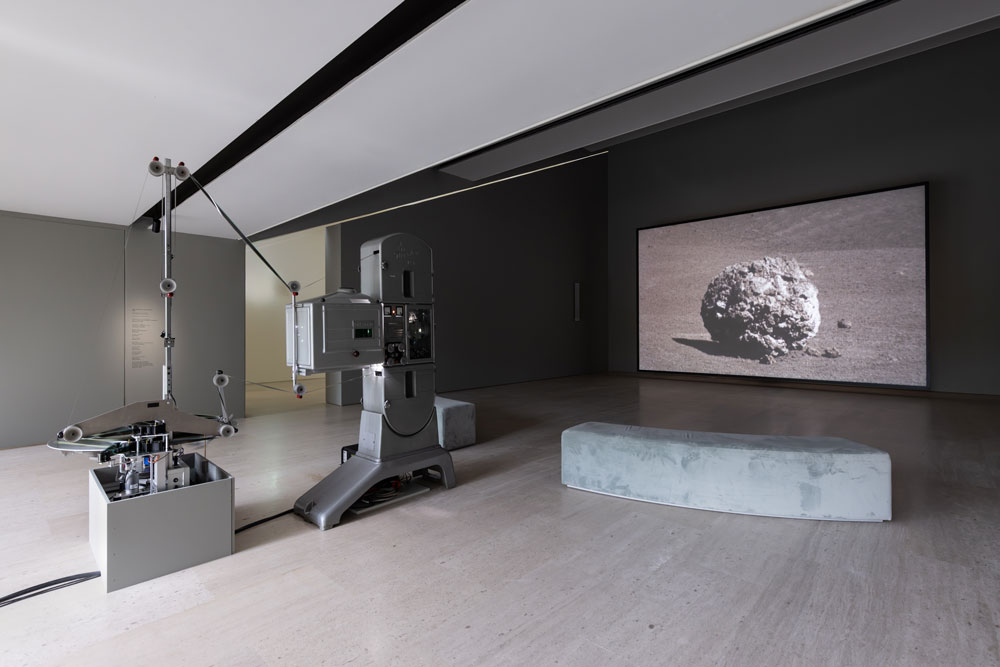
RB: One could speak about it as a form of expanded cinema, but that term has been associated with a very specific group of people at a certain moment in time. I relate to that, but I also do not. Because I do not think I make that kind of expanded cinema. I do want this re-configuration. There are pieces such as Myth and Mercury (2025) where there is maybe a more classical, single- screen approach. But then again, not entirely or conclusively, because you have this sculptural aspect, you have the machine, and you become fundamentally, intriguingly part of it. In a way you find yourself inside the machine while watching the film, which is something crucially important in these works. They put you into a mode of transportation through this looping device, and so on. And then there are other works where there is a much more direct relationship to sound, or to light, or to colour. Alas, it is an exploded vocabulary. It resembles a single letter of an alphabet. Then sometimes it is a word, and sometimes it is a whole sentence. These are the elements that. . . occasionally It is only a very zoomed-in conceptual idea, like The Real Sublime (2009), the suspended projector on its own celluloid. That is already a formulation of the idea of cinema.
Then you move to Myth and Mercury, and you enter an utterly different, much broader thought about the Mediterranean Sea and it’s deconstructions. In that sense it becomes very focused on one idea. And every now and then it opens onto a kind of cosmos.
MV: Further there is the curious connection between cinema and astronomy. Your research approaches cinema as a medium of light. What draws you to this relationship? Is cinema, for you, a way of overcoming absence? I am thinking of how moving images are carried by light, bringing us traces collected elsewhere and at another time. There seems to be a parallel with astronomy: telescopes allow us to see stars that no longer exist, so both cinema and astronomy operate as media that transport and translate light across time.
RB: I believe there is this desire to understand things that are not ‘full there’. . . and that are difficult to understand. They seem to be very close to us (those intimate registers) and to exist in just a slightly different layer, where it is dark for us. In some ways this could be said about neutrinos as well. It's about trying to shed light on a certain kind of knowledge that we haven't completely understood yet, and where our tools of measuring and analyzing are unable to ‘decode.’ And that's a cinematic experience too, where we have to use our imagination and fine-tune our senses. In that way, I believe astronomy is constantly shaping and refining our senses. It's about instruments that don't function perfectly, but that we need to refine and make them more receptive. Thinking about these overlaps helps us to see more, but also to see, sense, in a more metaphorical way.
MV: And here comes one final question about the film Send Me the Sky, Henrietta (2018). You talk about it in your book in a unique way, revisiting the history, overlooked histories and micro- histories, of astronomy and bringing back this woman, who was forgotten in the history of astronomy but played a significant role in scientific and astronomical discoveries.
RB: I got really obsessed with Henrietta Svan Levitt, the American astronomer who analyzed photographs of pulsating stars in distant galaxies, and who was trying to understand who she was. That was already in 2017 or 2018, when I went to the laboratory linked to the Harvard College Observatory, where all these women were doing their respective, highly specialized work. They were called human computers. There was beautiful friendship and extreme professionalism. . . and what they invented, what they achieved, was extraordinary.
The place itself was untouched. You could visit, be there, and still imagine how they had been sitting there, with all their things, instruments and tools, around them. Unfortunately, they've now started to dismantle the place. But when I was filming there, it was absolutely in the state in which it had been left, which helped me connect with that inspiring scientist.
:::
Rosa Barba (Itália, 1972) studied at the Academy of Media Arts Cologne followed by a fellowship at the Rijksakademie van Beeldende Kunsten, Amsterdam; and has completed her PhD with the title "On the Anarchic Organisation of Cinematic Spaces: Evoking Spaces beyond Cinema" at the Malmö Faculty of Fine and Performing Arts, Lund University in 2018. She has been awarded various prizes, i.e. the 46th PIAC, International Prize for Contemporary Art, of the Fondation Prince Pierre de Monaco in 2015 and the Calder Prize in 2020. Rosa Barba engages within the medium of film through a sculptural approach. In her works, Barba creates installations and site-specific interventions to analyze the ways film articulates space, placing the work and the viewer in a new relationship. Questions of composition, physicality of form and plasticity play an important role for the artist as Barba examines the industry of cinema and its staging vis-à-vis gesture, genre, information and documents. Her work has been exhibited at numerous international institutions.
Mariana Varela is a writer and poet. She has published Enigmas de Jaguar e Jasmim (2019) and Rotativa (2022), both with Urutau. She edited the literary mini-magazine Frente! and currently edits the literary magazine Letra Lenta. She holds a Master’s degree in Sociology, is pursuing a PhD in Philosophy, and writes articles on the intersection of philosophy and aesthetics. Her work has been published in magazines and anthologies.