





|
|
JAMES NEWITT E CARLOS M. OLIVEIRAACTOS DE LÍNGUA CARPINTARIAS DE SÃO LÁZARO R. São Lázaro 72 1150-199 05 SET - 18 OUT 2026 Actos de Língua: Finding a Common Language
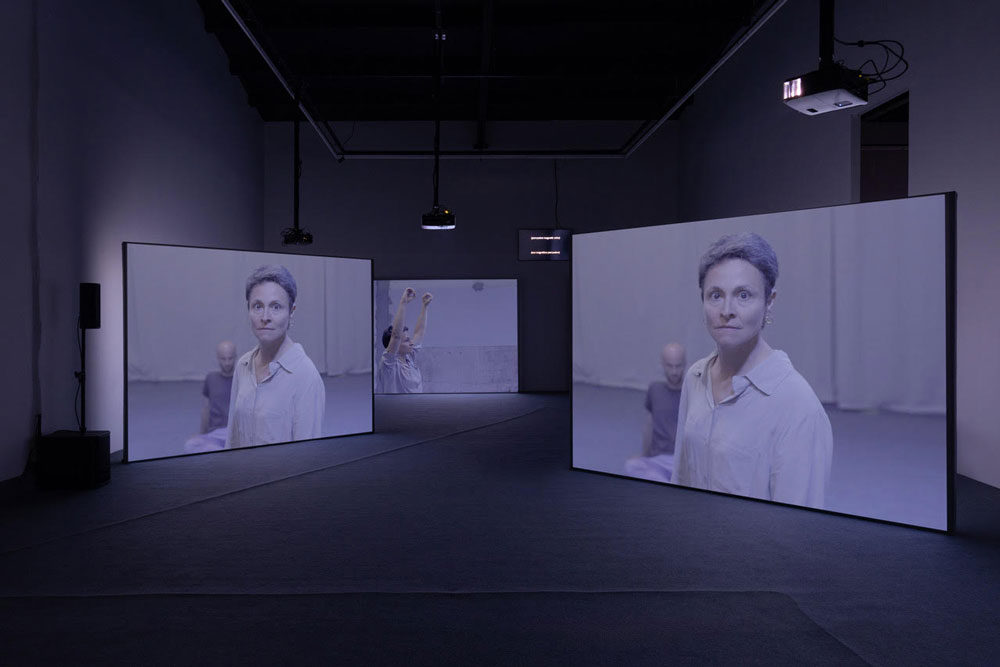
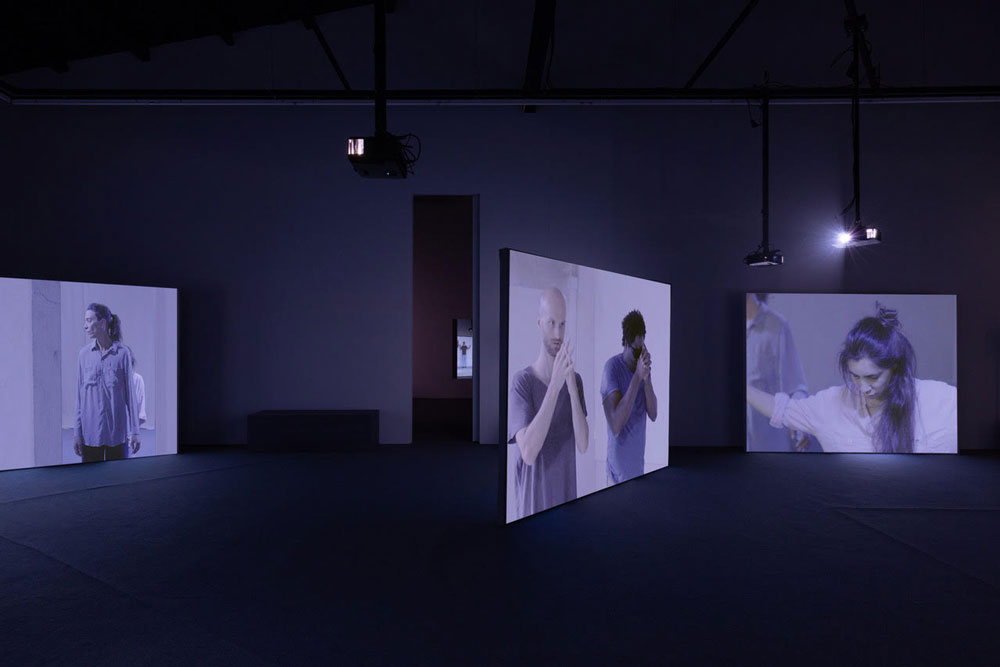
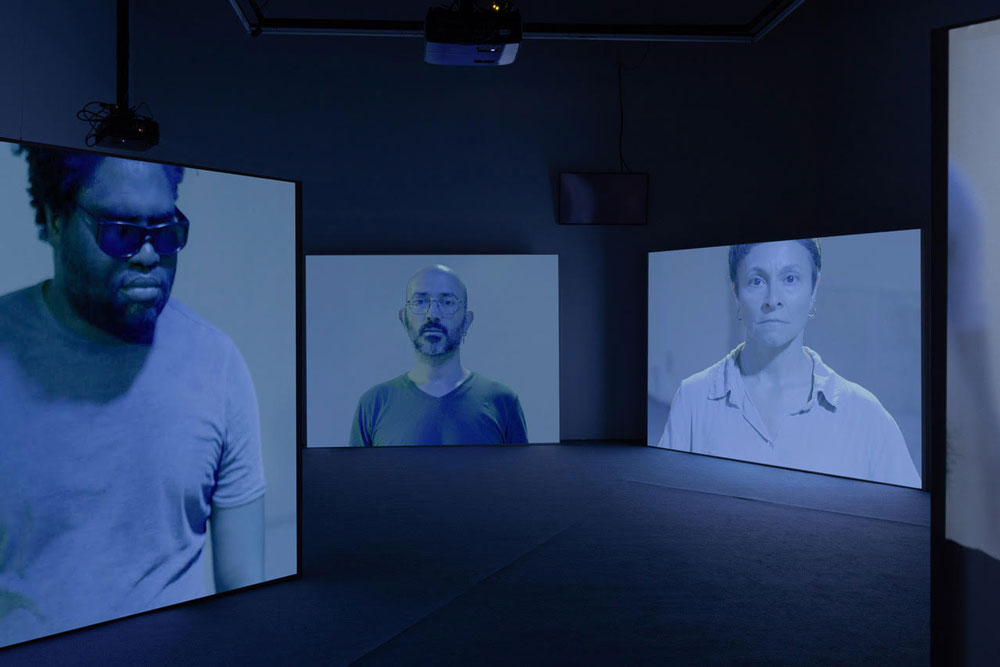
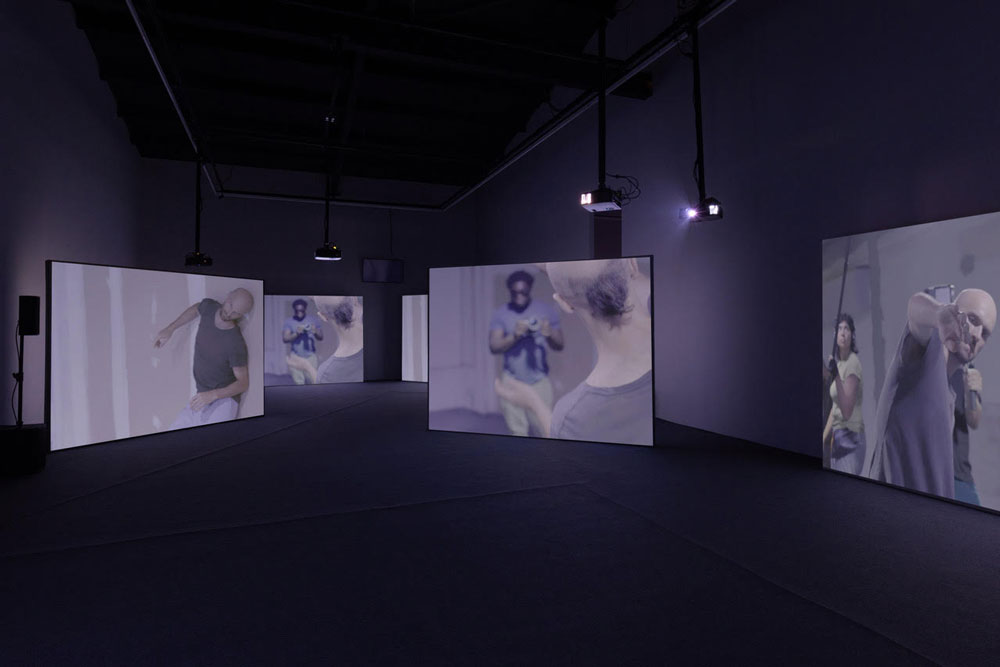
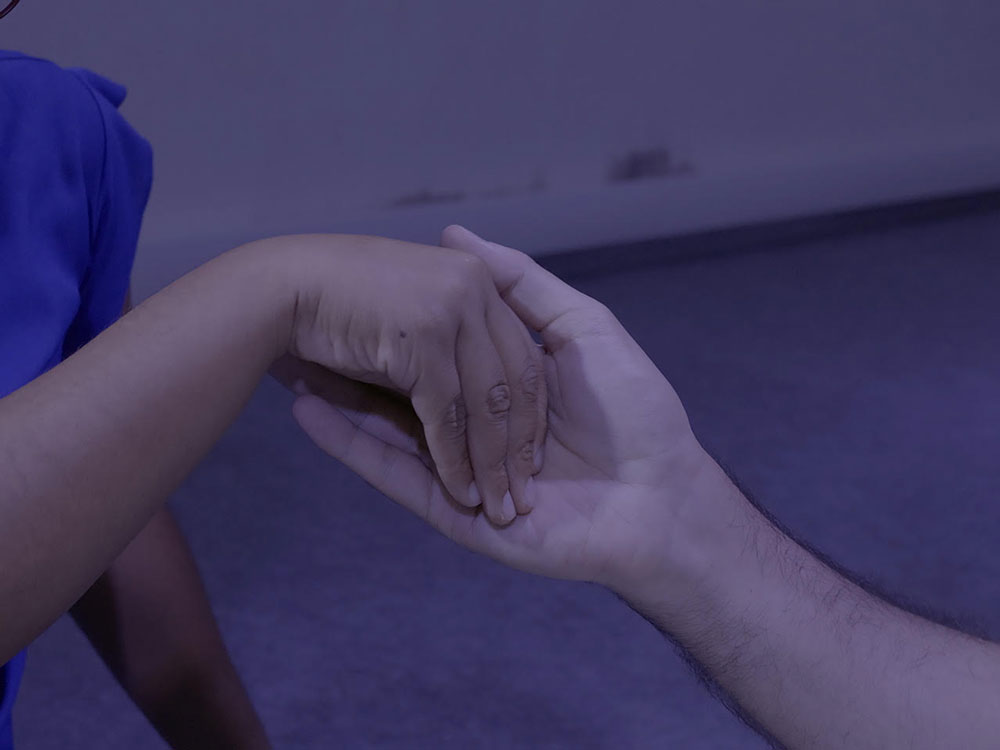
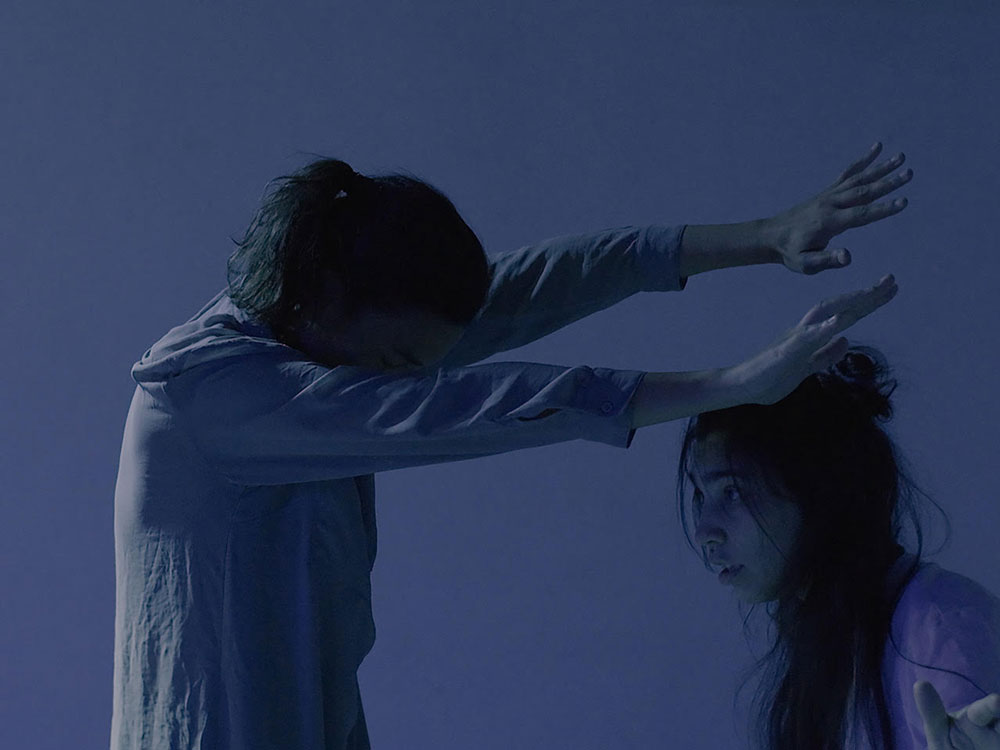
This need for shared languages is at the heart of Actos de Língua, an ambitious 44-minute video and sound installation by choreographer Carlos M. Oliveira and visual artist James Newitt, currently showing at Carpintarias de São Lázaro in Lisbon, until October 18, 2026. As we enter the darkened exhibition space, various configurations of six people appear around us, projected life-size onto six large screens. Rather than viewing films, we have a disorientating sensation of having entered a room occupied by people. These people look at each other and make sounds and gestures. They communicate through speech, sign language, lip-reading, movement and touch. Sometimes this communication seems straightforward; at other moments it is difficult to know exactly what is passing between them. Six-channel sound reinforces the visitor’s sensation of sharing their space. A sound comes from one part of the room, while an image responds from another. Visitors walk between screens to follow what is happening. Because the projectors throw visitors’ shadows onto the screens, our bodies briefly enter the images. Newitt and Oliveira have choreographed not only the people we are watching but equally ourselves.
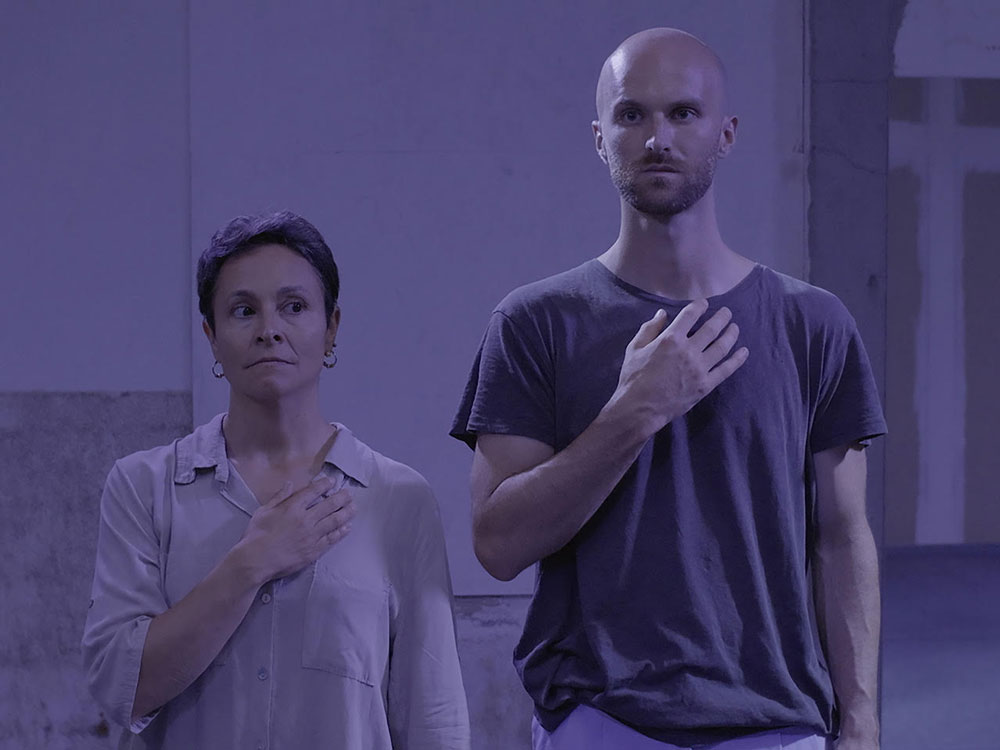
A language belonging to nobody and everybodyThe idea for Actos de Língua developed after Newitt and Oliveira participated in a workshop led by Portuguese dancer and choreographer Diana Niepce. Since a 2014 accident transformed her own relationship with movement, Niepce’s performances and curatorial projects have challenged the idea of the normative performative body. The group contained people with varying degrees of ability and disability, diverse physical and sensory relationships with their surroundings and different ways of communicating. Oliveira recalls a revealing moment when the participants stopped moving and sat in a circle. “When someone talked, there was the need for three, four, five simultaneous translations.” People began to help each other. A statement might need to pass through several people and several communication systems to travel around the circle. The conversation had begun to resemble choreography. “I guess what we were doing,” Oliveira says, “was generating choreographies of conversation.” Newitt and Oliveira subsequently assembled their own group and spent a month working with them in a studio. There was no script in any conventional sense. Instead, they devised exercises which Oliveira calls “choreographic propositions”: situations governed by certain rules, but without predetermined outcomes. Newitt describes these ‘propositions’ as attempts to find “emergent and therefore unpredictable things that would happen between participants.” A significant encounter involved Ana Ribeiro and Tony Weaver. Ana became deaf as an adult. She speaks and lip-reads but does not use sign language. Tony has been deaf since birth and he uses sign language. Considered together, they presented an intriguing paradox: both could communicate, but they did not possess an obvious common language. They began to create one. “We worked with them to build a common language that was no one’s specific language, but that was created collectively,” Oliveira explains. This ‘proto language’ might involve gesture, facial expression, touch, movement or sound. Its vocabulary belonged to neither participant and meaning had to be negotiated between them. It is difficult to experience Actos without thinking about the world outside the exhibition space. The great promise of social media was that it would connect people. Instead, it has widely participated in the creation of closed communities, characterized by their own specific references, assumptions and vocabulary. We can speak the same language and use the same exact words while understanding these words in fundamentally different ways. Actos offers us a counterimage: people beginning with profound differences and attempting to construct a language they can share.
The gaps between usFor Newitt, an interest in modes of communication has been integral to his artistic practice for many years. Australian-born and based in Portugal since 2013, Newitt makes films and installations that frequently start with real people, places, documents or events before moving into more speculative territory. Fact and fiction overlap; information is incomplete; a person’s experience can never be entirely recovered. Memory and forgetting are recurring concerns. The film Fossil, for example, originated in part in fragments of writings by the artist’s mother following memory loss caused by a cerebral aneurysm. In works such as Delay, I Go Further Under and Haven, isolation, withdrawal and uncertain narratives become ways of exploring the difficulty of gaining access to another reality. A thread running through all these works is communication across different forms of gaps: between one person and another, experience and representation, memory and the present, documentary fact and speculation. Actos places this concern in new territory. Rather than using film to reconstruct an absent or inaccessible experience, Newitt is in a room where communication itself is being constructed in front of his camera. Oliveira arrives in this room by a different route. Trained in contemporary dance and choreography, he has worked as choreographer, researcher and curator. His doctoral research examined how choreographic ideas can exist across different media, with subsequent research investigating how choreographic knowledge is transmitted between bodies and media through processes he describes as “transductions”. For Oliveira, choreography therefore extends far beyond arranging dance steps. Whatever medium he is working in, his way of thinking remains choreographic. In Actos an idea becomes a gesture; a gesture is interpreted by another body; movement becomes an image. The act of communication passes from one form into another and the idea emerges changed. Newitt’s interest in the gaps across which meaning must travel encounters Oliveira’s interest in the transformation of meaning while it is travelling.
Wittgenstein’s lionIn Philosophical Investigations, published posthumously in 1953, Ludwig Wittgenstein offered one of philosophy’s most memorable observations about the difficulty of understanding another being: “If a lion could talk, we could not understand him.” Wittgenstein’s point is not simply that we could not translate a hypothetical lion language, but that understanding depends upon shared practices and a shared ‘form of life’. The lion’s experience of the world would be so different to our own that giving it human speech would not necessarily bridge the divide. There is a compelling tension between Wittgenstein’s lion and Actos. Ana and Tony do not begin with a sufficiently shared linguistic system. But instead of accepting incomprehension, they try to construct the conditions under which they can communicate. “It’s not so much about disability,” Oliveira says, “it’s about differences between bodies and how a language is built up from their specifics.” Actos does not contend difference can be abolished. Communication arises precisely because differences remain.
Expanded choreographyThe work belongs to the broader development in contemporary art generally referred to as ‘expanded choreography’: choreography can organise not only dancers but equally objects, images, architecture, technologies, spaces and spectators. A 2012 conference in Barcelona, Expanded Choreography: Situations, Movements, Objects, placed choreography in relation to structures and strategies detached from conventional dance. French choreographer Xavier Le Roy’s Retrospective, first presented at Barcelona’s Fundació Antoni Tàpies in 2012 and later at MoMA PS1, was a significant example of this. Inside the gallery, performers continually recycled and transformed material from Le Roy’s previous works. MoMA described it as a hybrid of choreography and visual art that turned the exhibition format itself into a creative medium. Anne Imhof’s Faust, created for the German Pavilion at the 2017 Venice Biennale, provides a more spectacular example. The five-hour work combined performance, sculpture, painting, music and architecture. Its choreography extended throughout the pavilion with performers occupying different levels and locations while spectators were obliged to move and continually change their sightlines. Actos occupies related territory, although its concerns are very different. Its choreography encompasses the participants’ movements, Newitt’s camera, the editing between six screens, Diogo Alvim’s spatialised sound and finally the visitors moving through the installation. Newitt filmed using a fixed lens, with no zoom. To approach a face or hand he had to move his own body closer; to widen the image, he retreated. The camera consequently became another body in the choreography.
Hearing with the bodyAlvim’s sound design follows the same principle. There is no conventional musical soundtrack imposed upon the images. Much of the material comes from sounds generated during filming: mouths clicking, skin and bodies interacting with the room. Distributed through six channels, these sounds participate in transforming the exhibition space from a screening space into a shared environment. Individual participants describe different sensory experiences. One talks about sensing shadows when approaching a wall; Ana describes her individual physical perception of sound. Each account is given equal weight. The question becomes less “what can this body not do?”, and more “how does this body experience the world?”
A changing Portuguese landscapeThere is a specifically Portuguese dimension to all this. In Oliveira’s view, Actos could not have been made in quite the same way two decades ago. In Portugal, non-normative artists have become increasingly visible as performing arts professionals rather than simply appearing as the subjects of socially orientated projects. "20 years ago, it was not like this,” he says. Cultural institutions are also increasingly considering accessibility: who can enter cultural spaces, who can experience what happens inside them, and whose body is unconsciously treated as the norm. Actos reflects this shift without making disability its subject. Instead, different sensory and communicative capacities become part of the material from which the work is constructed. Newitt and Oliveira point out that an installation of this technical complexity would more often be associated in Portugal with a major institution. Instead, they have exercised production independence and developed their own transferable exhibition system. And what a system! Behind the apparent simplicity of six people occupying a room lies an elaborate network of synchronised video and sound, audio description, subtitles, double-sided screens and more than a kilometre of cabling. But we almost cease to notice the technology. It is the people that remain visible.
Sharing a roomThis may ultimately be Actos de Língua’s most affecting achievement. The six screens cease to operate as six channels of information. After we have spent time in the installation, the screens take on the character of six people with whom we are temporarily sharing a room. Narrative, in the conventional sense, is replaced by glances, hesitations, repetitions, failed attempts, discoveries and moments of understanding. We become attentive to tiny acts of communication that generally pass unnoticed. This is where Actos has a message beyond interrogations on choreography or disability. We inhabit societies equipped with communications technology that has never been so sophisticated, yet we appear increasingly unable to agree upon a common reality. Faced by incomprehension, the temptation is to retreat to the reassuring company of people who speak as we do. The participants in Actos do something else. They start by recognising their differences, without assuming meaning will travel intact from one person to another. They look, listen, touch, gesture, repeat, misunderstand and, when necessary, try again. Eventually, between them, something resembling a language begins to emerge. A form of language that belongs to nobody. Which is precisely why everybody in the room can begin to share it.
***
James MayorBorn in the United Kingdom, writer and journalist James Mayor has lived and worked in France, where he owned a contemporary art gallery, acted as a consultant to the luxury goods industry, and translated catalogues for museums including the Louvre, Musée des Arts Décoratifs and Musée Guimet. James has lived in Portugal since 2014, where he writes about culture, cause and wine.
|