





|
|
ROSA BARBADRAWING VOCABULARIES CAM - CENTRO DE ARTE MODERNA Rua Dr. Nicolau de Bettencourt 1050-078 Lisboa 16 MAI - 28 SET 2026
…Time is an Editing Suite
Giovanni Battista Della Porta, native of Naples, was a magician-scientist, philosopher, cosmologist, and playwright who wrote Natural Magic in 1558. This book is historically situated within a period of significant scientific revolution, during which alchemy gradually moved away from the Aristotelian tradition and took on an increasingly rationalist, scientific, and autonomous character. Della Porta maintains a mindset and a lexicon that remain deeply alchemical in the revelation of his discoveries: it is the mysteries, the secrets, the forms, and the rhythms of nature that must be carefully unraveled by the scientist, radically distancing himself from a tyrannical and extractivist approach that could be represented by Francis Bacon. Della Porta was a key figure in the study of optics, having been one of the pioneers in comparing the camera obscura to the human eye—the pupil as the aperture and the retina as the projection screen—; having explored the refraction of light and the behavior of light rays in different media, and introduced the use of crystal lenses and concave mirrors to improve focus and make the projected images sharper. He thereby influenced the subsequent creation of the magic lantern and telescopes. Today, given the ubiquity of the images that constantly fill our lives, we may not fully grasp how the projection of images through optical devices at that time took on an otherworldly quality that brought these phenomena closer to the magical and the ghostly. How could the image of something be where it is not? What is this mechanism that allows a thing to be and not be at the same time? That disembodies and embodies, that produces effects and settles into the human senses as if it were with us? Della Porta teaches, in Natural Magic, how we can attain a vision of that which is immensely far away—or even of that which is no longer here. The telescope, cinema, photography, and the projection of images share, after all, this most fundamental similarity, characteristic, and capacity: access to the image of what is no longer here, its spatiotemporal transport, its cosmic movement through a set of devices and procedures that involve, above all, the mysteries of light.
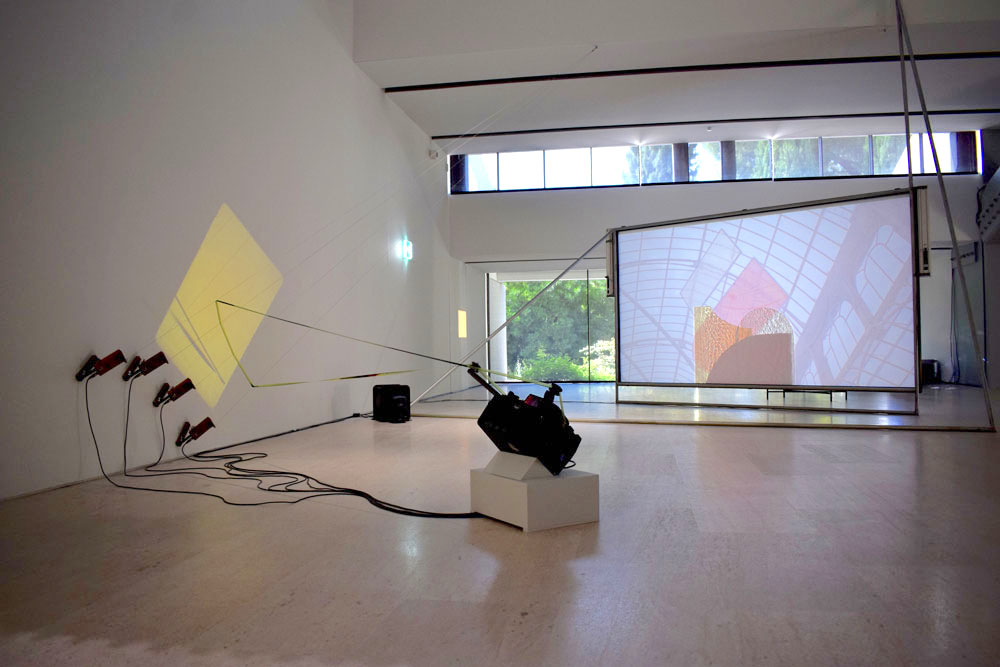
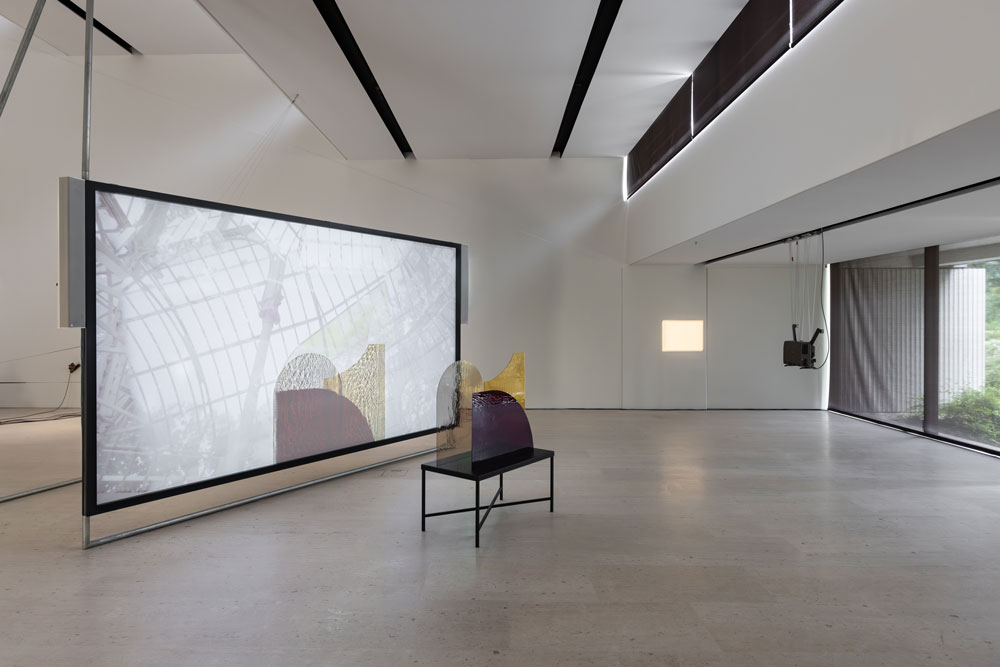
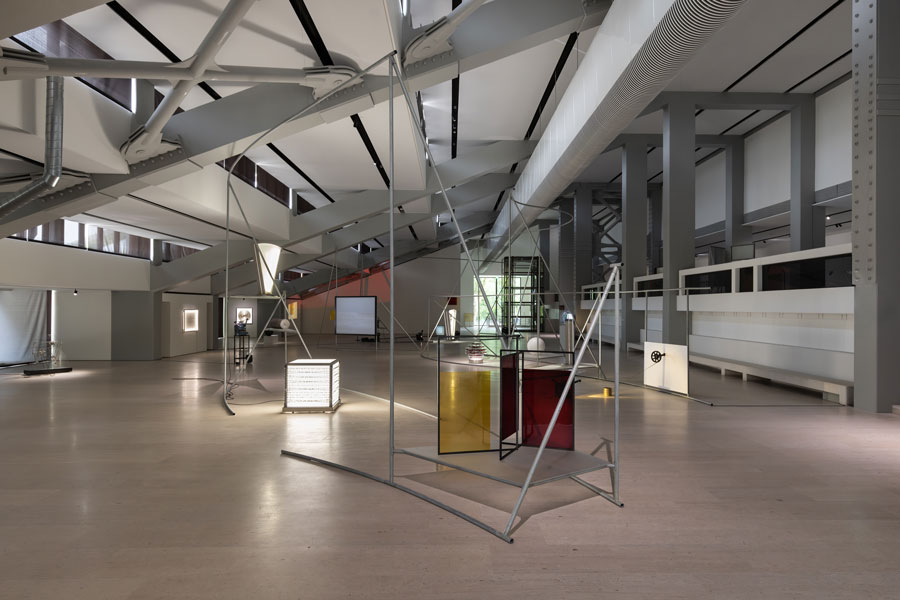
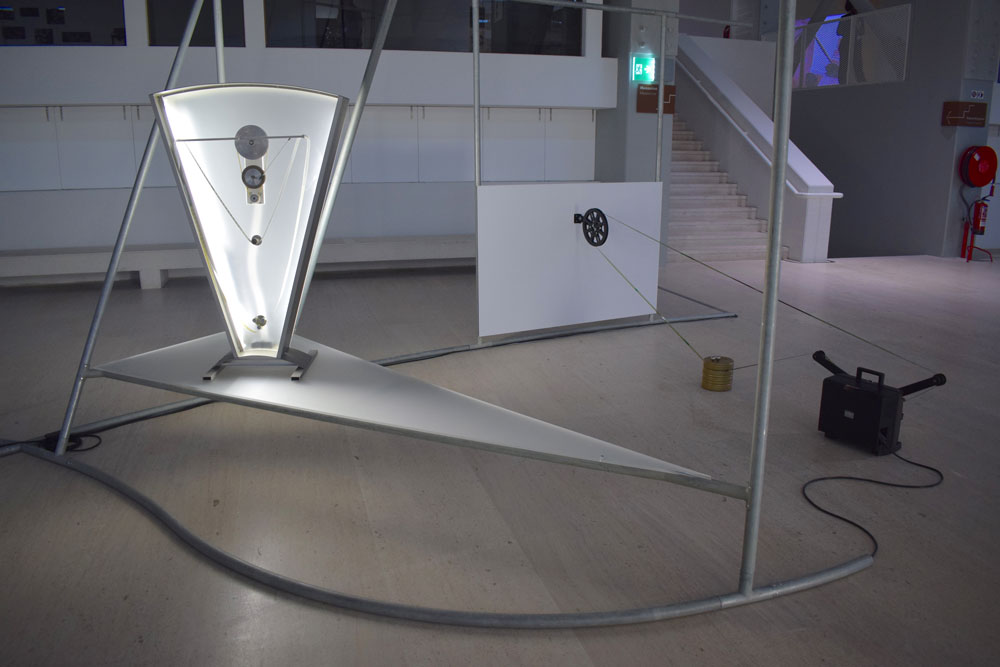
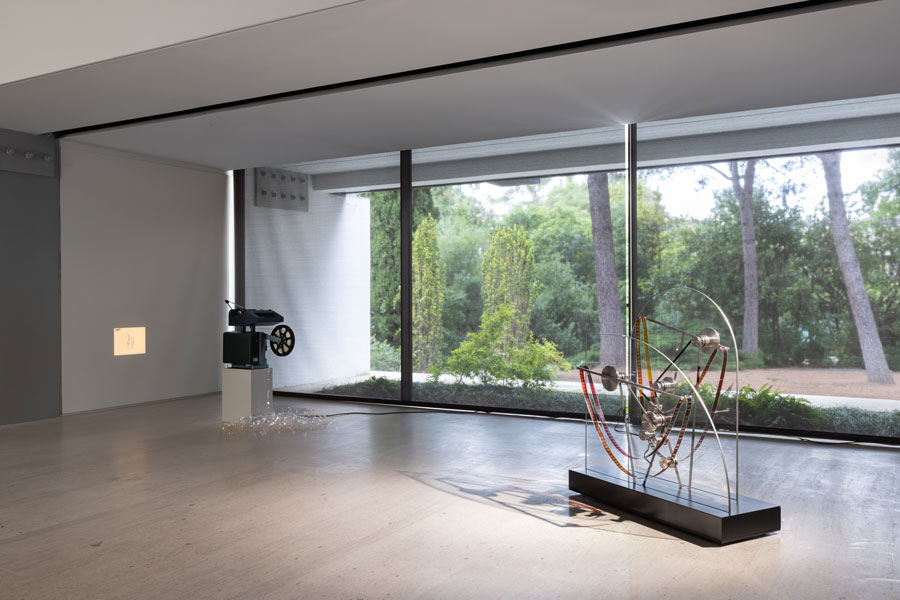
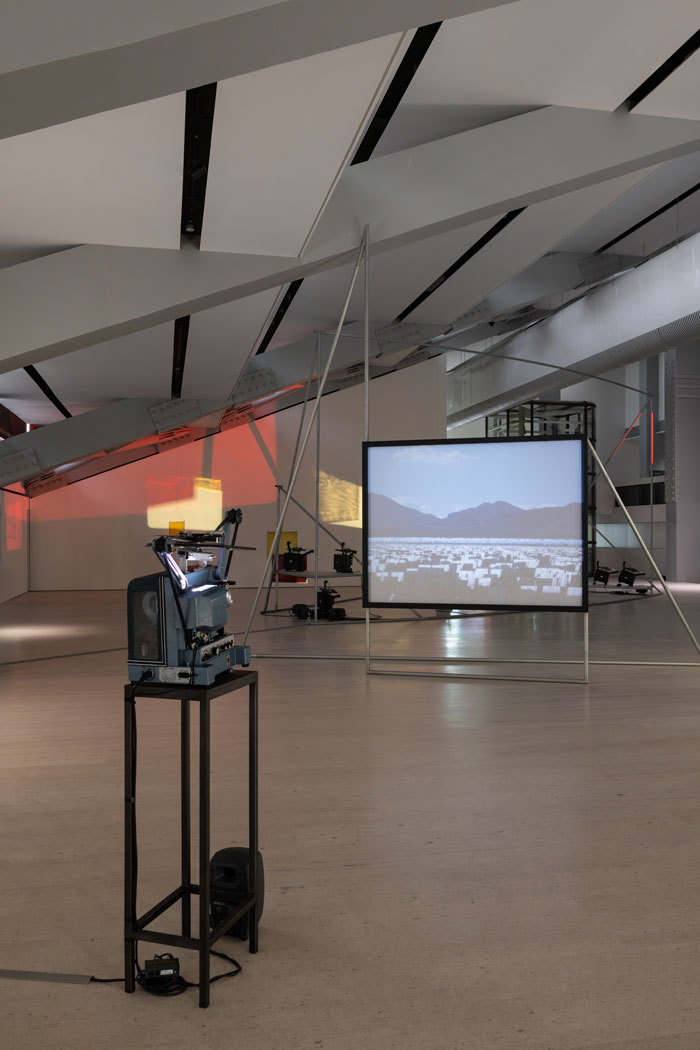
Rosa Barba, Color Clocks: Verticals Lean Occasionally Consistently Away from Viewpoints, 2012. 35mm film, motors, aluminum, plexiglass. Exhibition view, Rosa Barba: Drawing Vocabularies, CAM - Gulbenkian. © Artecapital
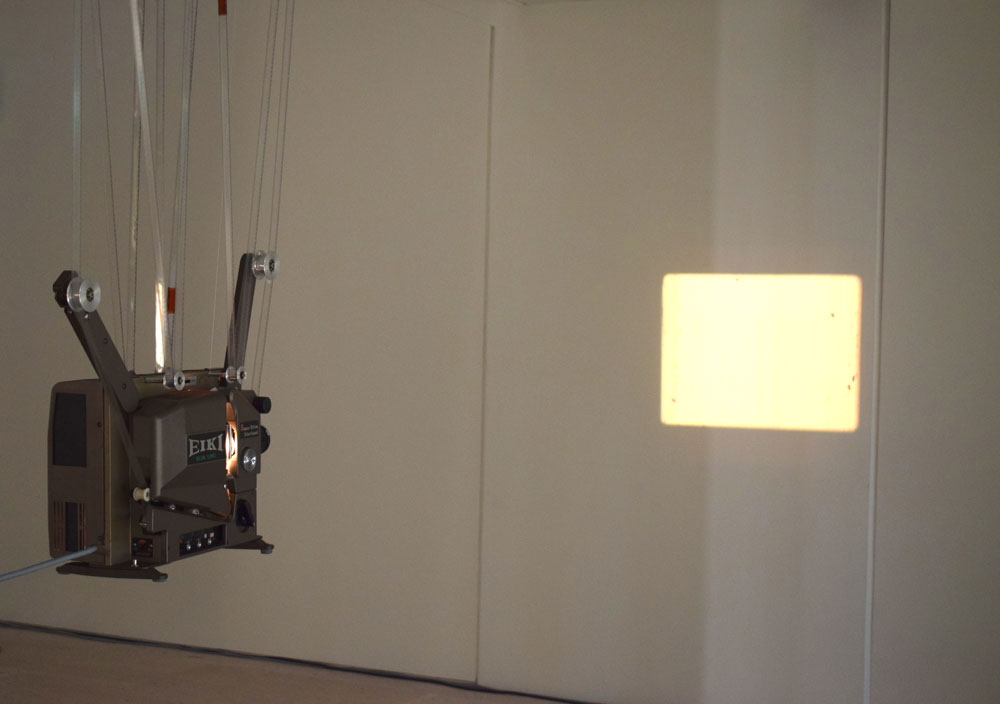
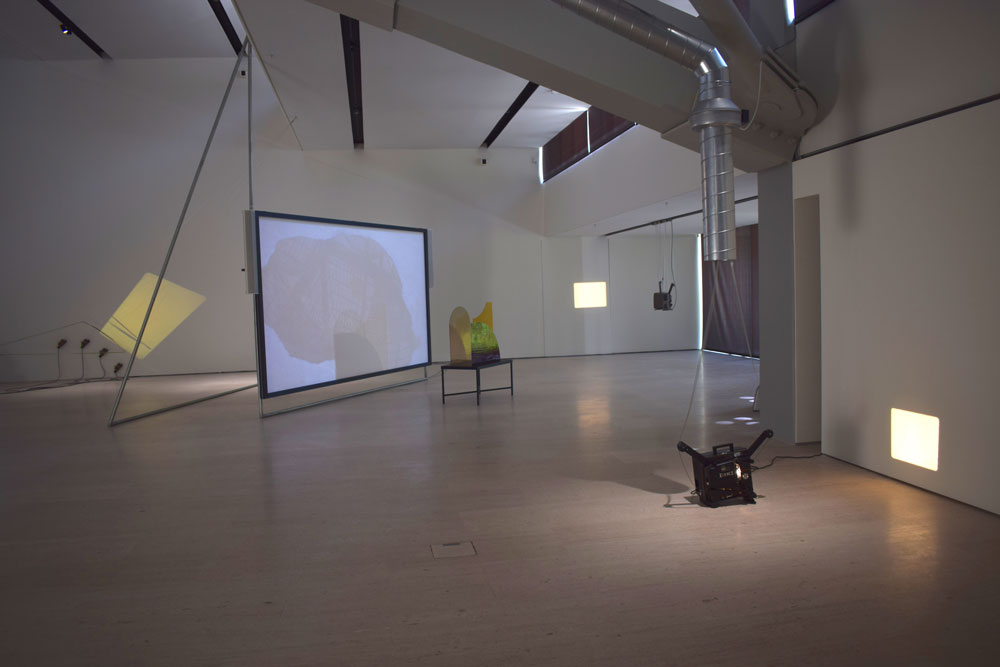
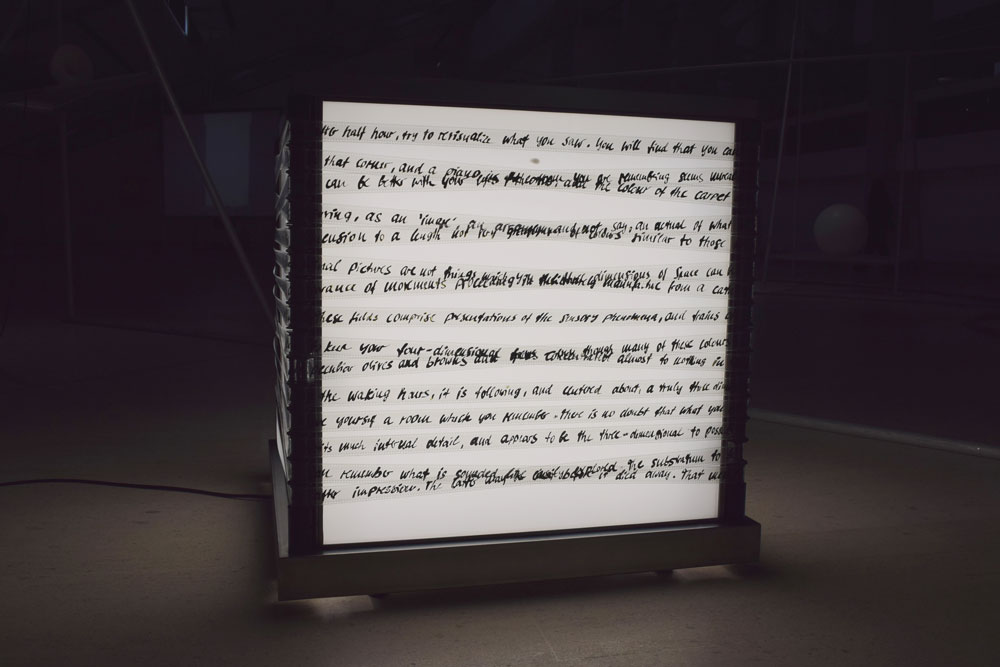
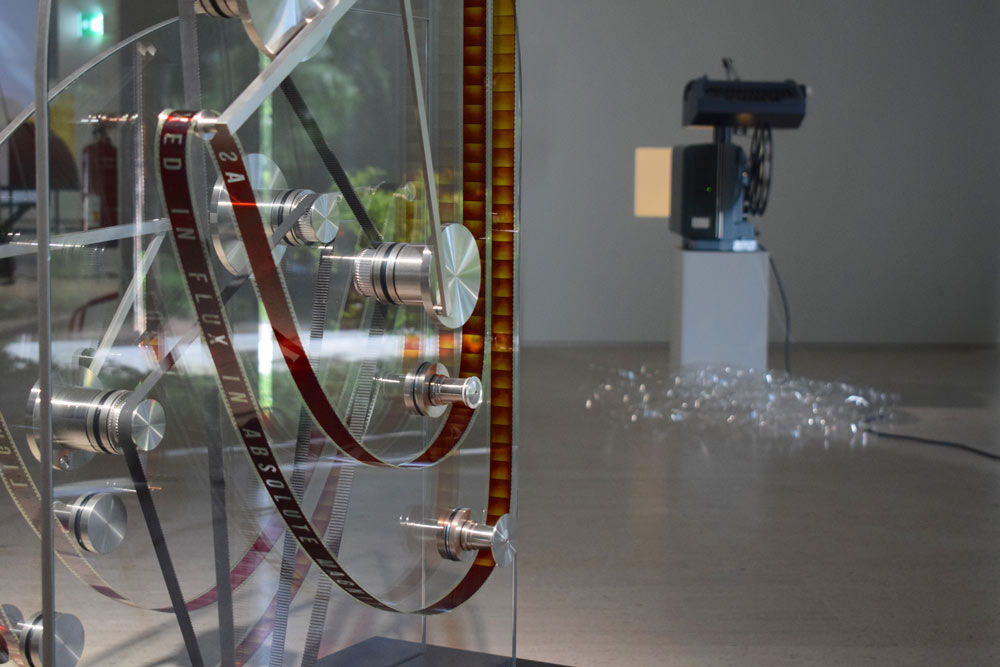
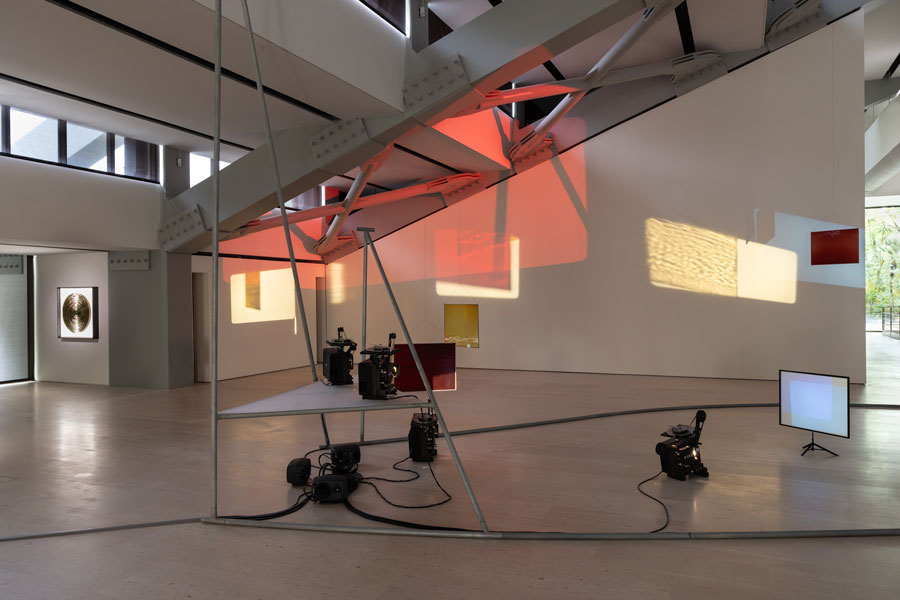
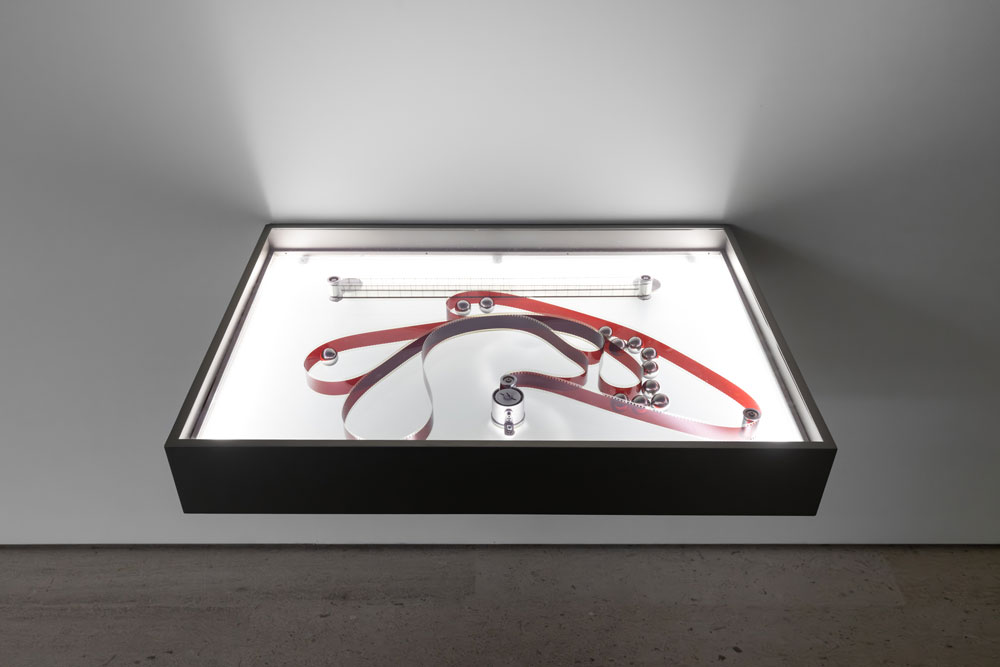
From May 16 to September 28, CAM - Gulbenkian will host Rosa Barba’s exhibition, Drawing Vocabularies. The Italian visual artist arrives in Portugal following a recent exhibition at MoMA (2025), having previously exhibited at the Tate (2023), the Pompidou (2023), the Reina Sofía (2017), and the MAXXI (2014); and after winning the Zurich Art Prize in 2026. This gives a sense of the artist’s solid presence in the international contemporary art scene. Barba works primarily with the intertwined relationship between cinema, sculpture, and architecture, reinventing kinetic form through experiments in expanded cinema. Her exhibitions are characterized by an opening up of the film apparatus to transform it into an artifact that is both sculptural and architectural: Barba reveals and modifies the functioning of the projection machine; she experiments with and reorganizes its components; and she sets them to work symphonically with the space. Her work reveals a strong appreciation for cinematic forms, which become true sculptures, and a strong conceptual character, evident both in the exhibition format and in it’s approach to what cinema entails: the projection of images, reality as a temporal phenomenon, and its relationship with physics and astronomy. At CAM, an exhibition space has thus been created that blends film production and projection, uniting front and back into new sculptural forms. In this space, inside and outside cease to function as relevant categories: it is an aesthetically mechanical and projective environment, in which what we see emerges through the very devices that constitute it. What appears is not separate from the material conditions of its appearance; on the contrary, it reveals them. By approaching, as expanded cinema, procedures associated with constructivism and brutalism, Barba’s work makes material visibility a formal principle. It is a gesture of dissolving the boundaries between medium and image, process and work, interior and exterior. But its conceptual strength, as far as I can see, is not merely a formal matter: it also touches upon the physical principles of reality’s constitution, bringing cinema closer to the mysteries of light and time, of astronomy and travel. Consider, for example, the work In play (Hopscotch), 2024. Endowed with a strong rationalist, mathematical, and combinatorial character, the piece flirts simultaneously with the algorithmic programming of image production and with the processes of constructing reality as a procedural event. In this work, through the abstraction of combinatorial elements, an image—but also a spatiotemporal point—is created, dissolving immediately afterward; reappearing at another moment.
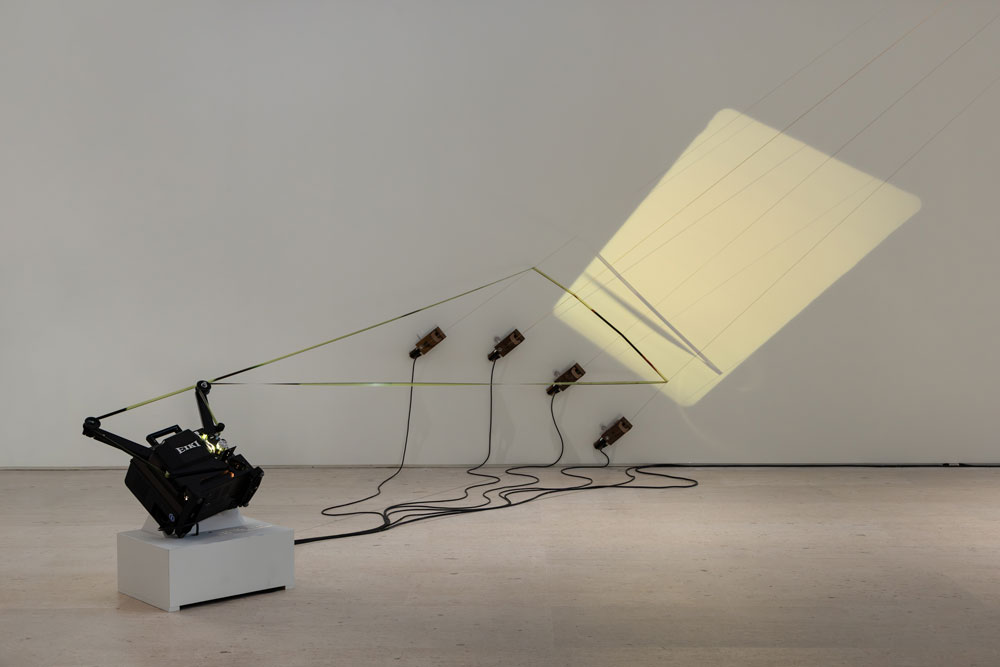
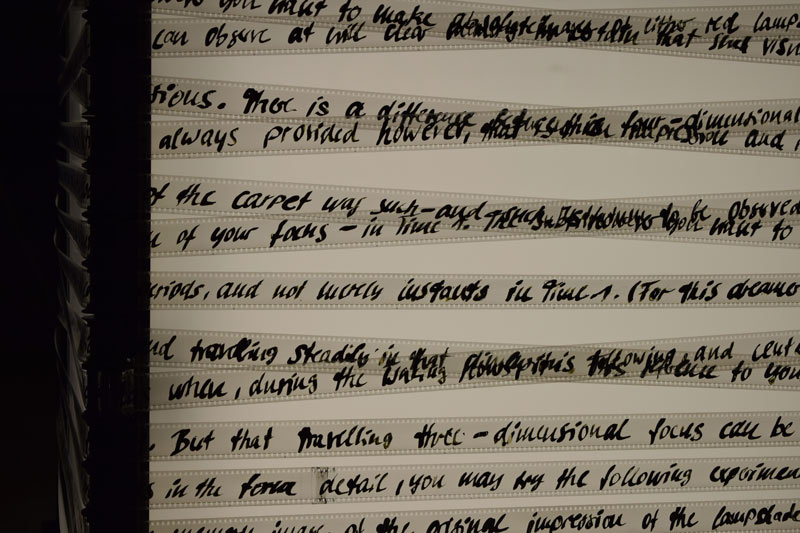
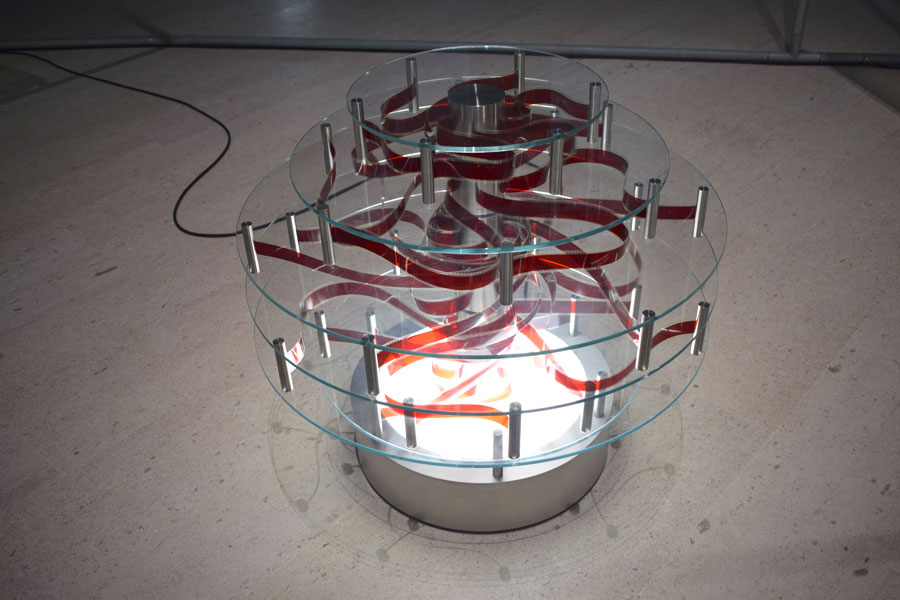
Rosa Barba, In Play (Hopscotch), 2024. 35mm film, aluminium frame, motors, plexiglass, LED lights. Exhibition view, Rosa Barba: Drawing Vocabularies, CAM - Gulbenkian. © Bruno Lopes
**
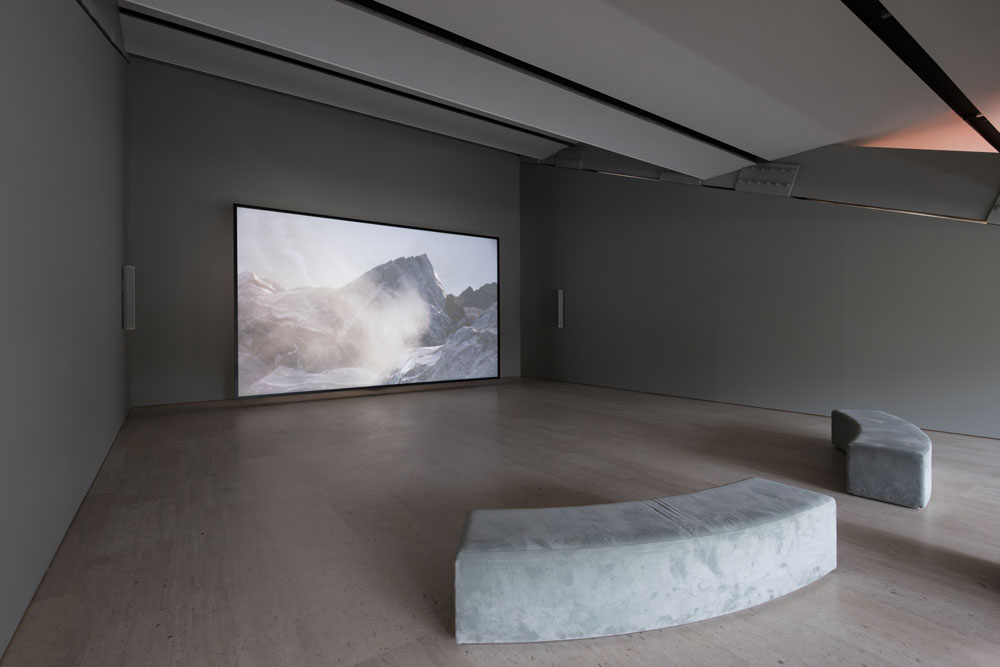
It is important to note that Barba is a professor of Art in Space and Time in the Department of Architecture at ETH Zurich. This suggests that we may not be dealing with a merely aesthetic treatment of conceptual issues, but rather with material experiments that seek to establish a dialogue with the enigmas of light, duration, and the construction of reality as a cosmological event. The composition of a space that is itself performative, traversed by pieces that communicate with one another within a projective body—composed of site-specific pieces and events—can be understood as a kind of stylization of the real as a combinatorial form of chance and events. That is, as a game of chance and programmed probability, in which the infinite and the occasion appear as raw material that organizes both mathematical forms and reality itself. On the other hand, it is undeniable that Barba’s work contains a strong aesthetic component: her exhibitions feature sculptures of the utmost elegance and imbued with profound meaning and beauty, as well as a distinctive exhibition aesthetic—that is, a unique way of addressing the issues dear to her and inscribing them as a style. This aesthetic does not refer to the particularity of a single work, but permeates the entire exhibition, marked by an extensive use of straight lines, geometric structures, the use of red and yellow as primary colors, and the use of devices imbued with rhythmic mathematics. There is an aesthetic suggestion evoked by some of her works that recalls the experiences of the Italian Arte Programmata of the 1960s, which also focused on kinetic art and combinatory and constructive interaction in the production of images. But in Barba’s work, also due to the strong cinematic and projective component of her practice, we are not faced with an exhibition that conceives machines precisely as a promise, but rather as artifacts of temporal and material reorganization of space. That is, also as a specter, a ghost, and a spatial reconfiguration. Thus, although Barba’s installations retain echoes of Constructivism and Moholy-Nagy’s light experiments at the Bauhaus, Barba moves toward a situated cinematic phantasmagoria, bringing a renewed architecture to the exhibition space and linking it to other geographical spaces, brought to life through the use of films and projected images. Films like Myth and Mercury, which is on display at CAM, show how Barba’s work is oriented toward a truly expanded space—the ocean floor, the Mediterranean, desert landscapes. And how Barba explores the connection between time and geography. In Myth and Mercury, also marked by the figure of Antonio Gramsci and his prison notebooks, side by side with images of a Catholic procession, there is a certain deep melancholy that captures temporalities that are both historical and geological. The use of 16mm film also lends the film an air that feels somewhat old from the start—implicating the temporal questions listed above in the very materiality of the medium. In this sense, it may be worth emphasizing once again the fact that, when looking at the cosmos, we may always be facing images of celestial bodies that no longer exist. But which, at the same time, through the mysteries of light—do exist. This is precisely the raison d’être of the encounter between optical devices, cosmology, and the mysteries of space-time. In this encounter, reality itself, being a temporal reality, also contains its phantasmagorical aspects. Even without the images, we can get there. If, on the one hand, Gramsci (Myth and Mercury) is no longer here with us; it remains true that—through the force of history and his memory—he still is.
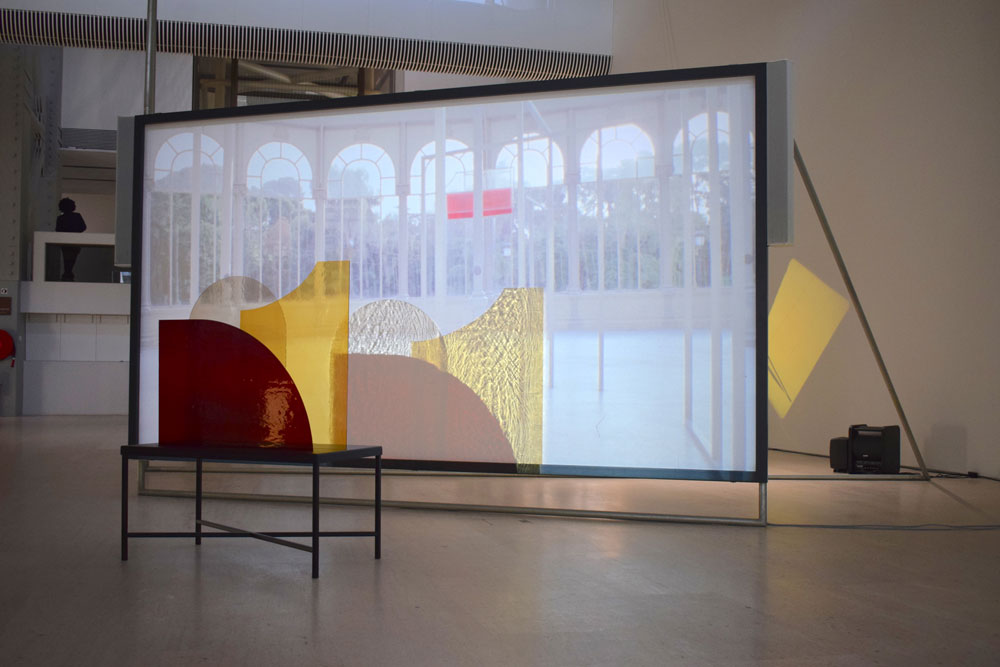
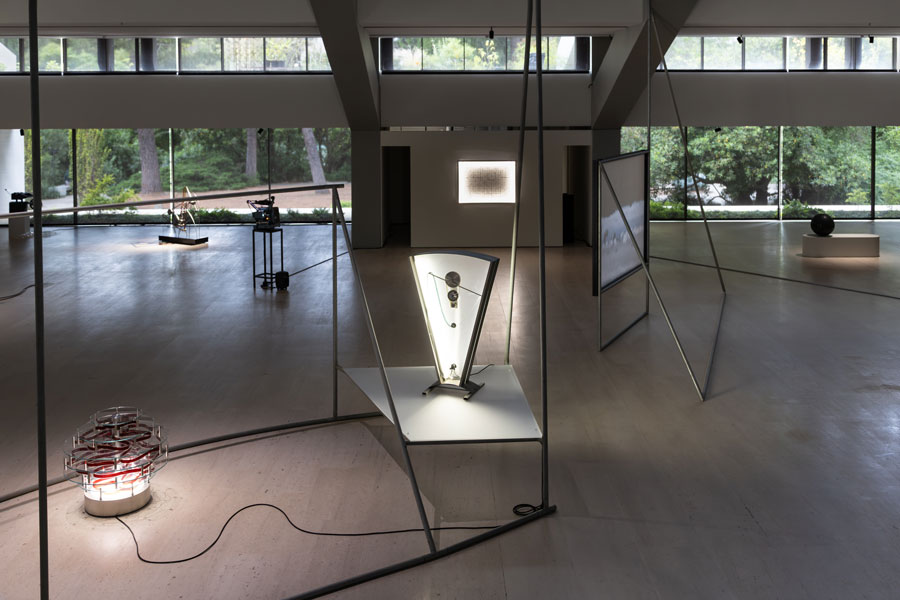
Rosa Barba, Myth and Mercury, 2025. 35mm film, colour, optical sound, 22’. Exhibition view Rosa Barba: Drawing Vocabularies, CAM Gulbenkian. © Bruno Lopes
Rosa Barba, Myth and Mercury, 2025. 35mm film, colour, optical sound, 22’. Film stills © Rosa Barba. Co-commissioned by Fondazione MAXXI and CAM - Centro de Arte Moderna Gulbenkian. Co-produced by Fondazione In Between Art Film and Hamburger Kunsthalle
Perhaps this is precisely where Rosa Barba’s work once again intersects with Della Porta’s. Not only in optical machinery, lenses, projections, and lighting devices, but in the realization that the image is not a mere representation of the world. From the concave mirrors of natural magic to contemporary telescopes that observe galaxies as luminous traces of a universe that no longer coincides with itself, seeing has always meant entering into a relationship with something that is no longer entirely here. All vision, in this sense, is traversed by durations, distances, and survivals. The cosmos appears less as a fixed set of objects than as an immense montage of temporalities in transit. In this sense, Barba’s filmic sculptures appear as machines of perception, themselves redesigned, our perception itself redesigned by the material, the architecture, and the images. At the edges of this revisited materiality hovers the intuition that the world is not constituted by stable things—but by events, rhythms of relation, and processes of emergence. Cinema thus emerges as one of the most sophisticated ways of organizing phantasmagorias of light. Not to escape reality—though it does that as well—but above all to suggest that reality itself already possesses something spectral, discontinuous, and astronomical.
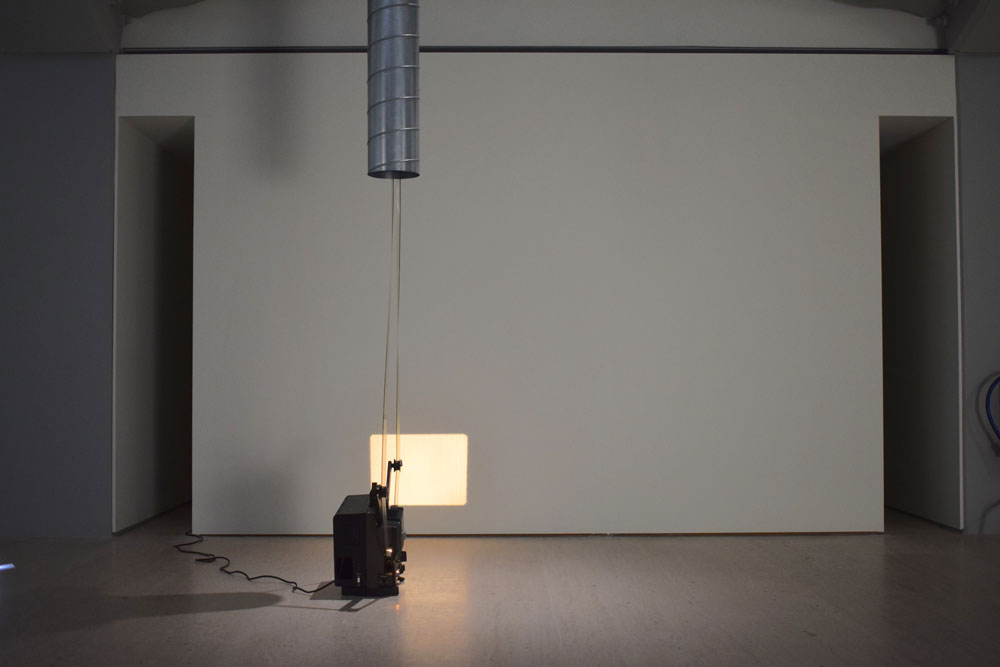
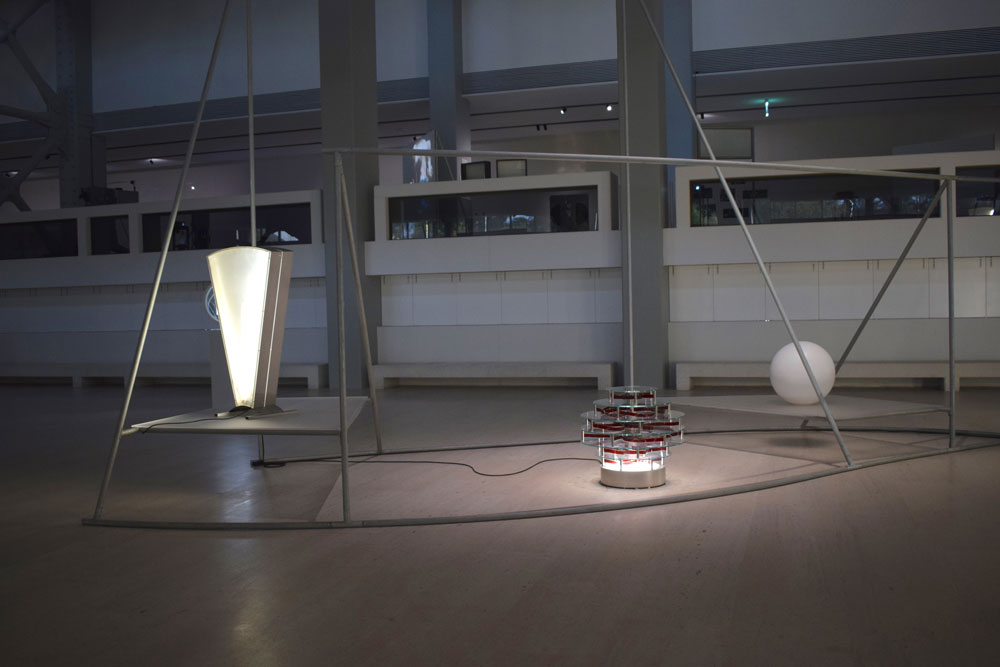
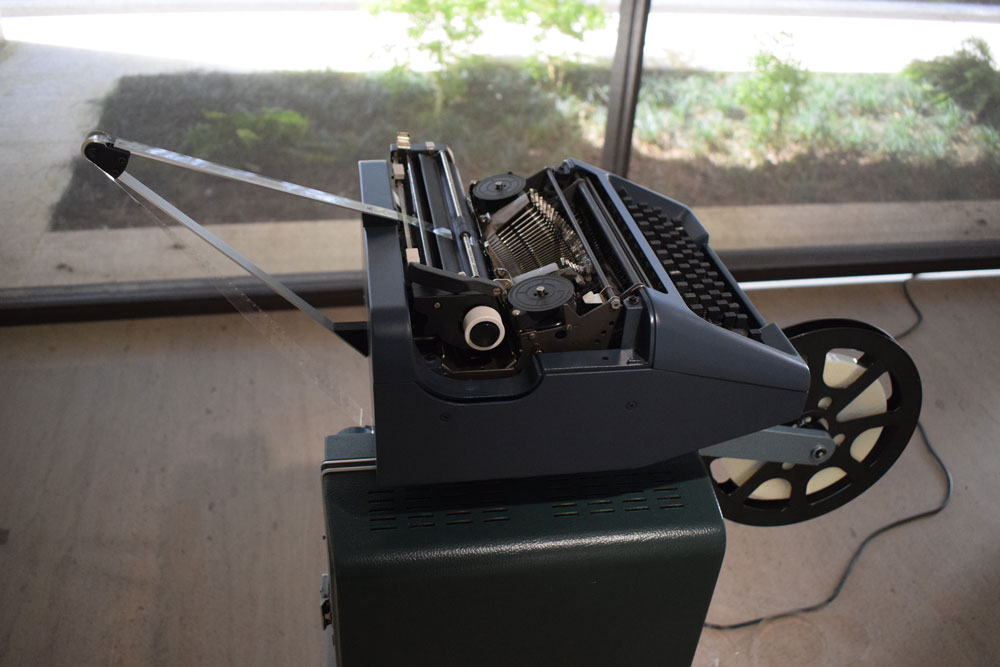
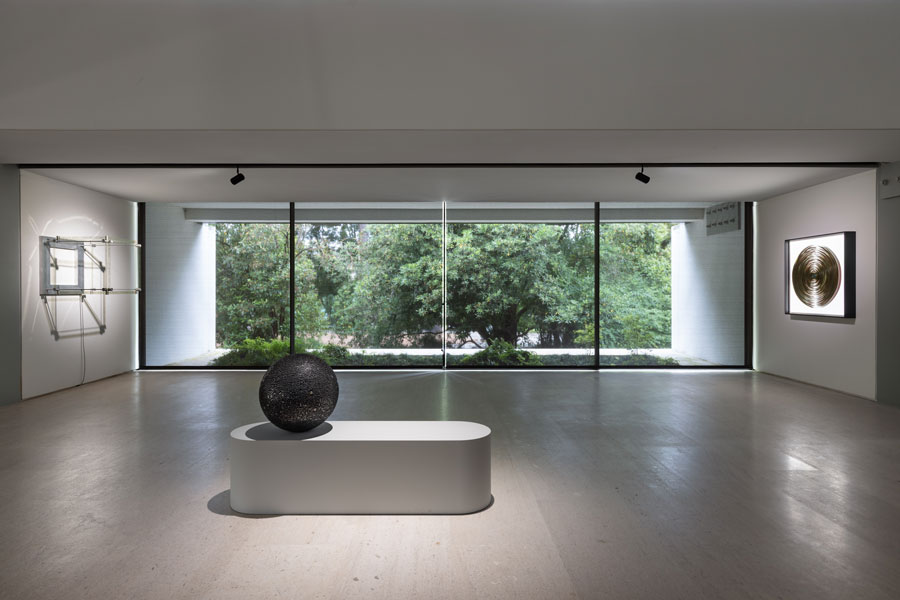
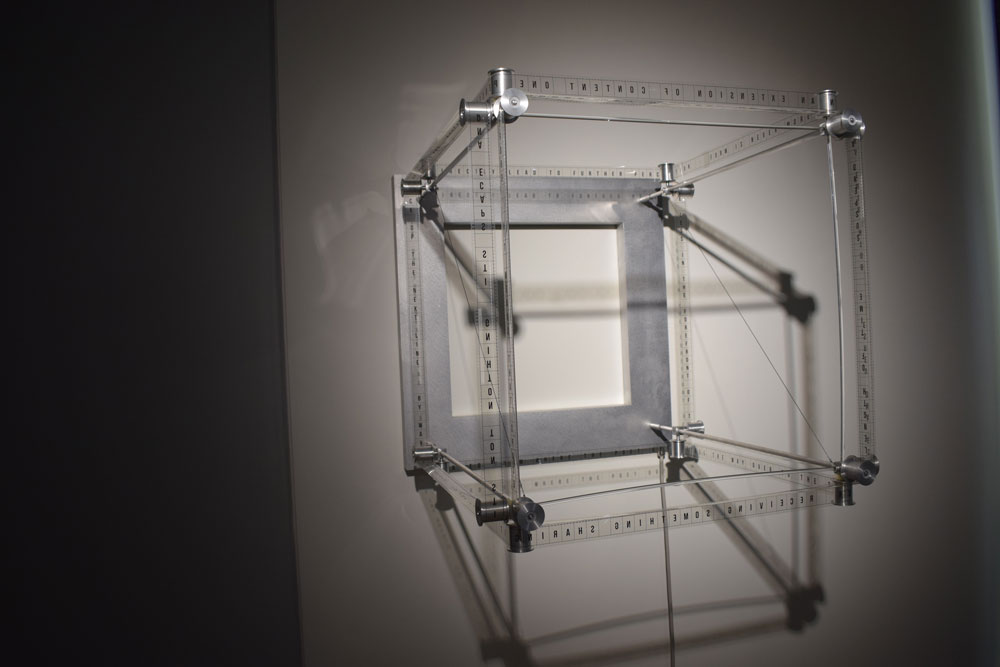
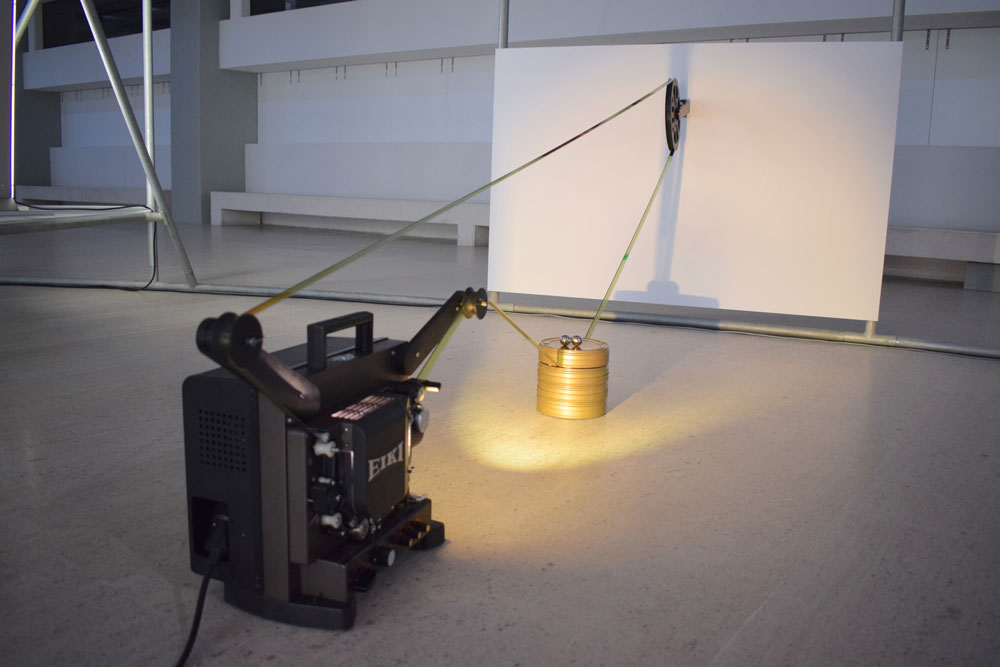
Rosa Barba, Boundaries of Consumption, 2012. 16mm film, modified projector, film cans, 2 metal spheres. Exhibition view, Rosa Barba: Drawing Vocabularies, CAM - Gulbenkian. © Artecapital
Drawing Vocabularies may be, among other things, about this kind of stylization of perspective and temporal mathematics—one that traverses cinema, astronomy, and the very mystery of reality’s emergence. In this kinetic collage, there are resonances of the past in the present, and there is also a variable set of layers that interfere with the emergence of things in space-time, making the present both possible and impossible. In these resonances, where conceptual questions become aesthetic and aesthetic questions reveal the conceptual, Barba is once again preparing a new machine.
Mariana VarelaShe is a writer and poet. She has published Enigmas de Jaguar e Jasmim (2019) and Rotativa (2022), both with Urutau. She edited the literary mini-magazine Frente! and currently edits the literary magazine Letra Lenta. She holds a Master’s degree in Sociology, is pursuing a PhD in Philosophy, and writes articles on the intersection of philosophy and aesthetics. Her work has been published in magazines and anthologies.
|
.jpg)
.jpg)
.jpg)
.jpg)
.jpg)